
 by
by The global indoor positioning and indoor navigation market is undergoing rapid transformation as organizations increasingly adopt real-time location technologies. The market is projected to grow from USD 14.34 billion in 2026 to approximately USD 82.73 billion by 2035, expanding at a CAGR of 21.5%.
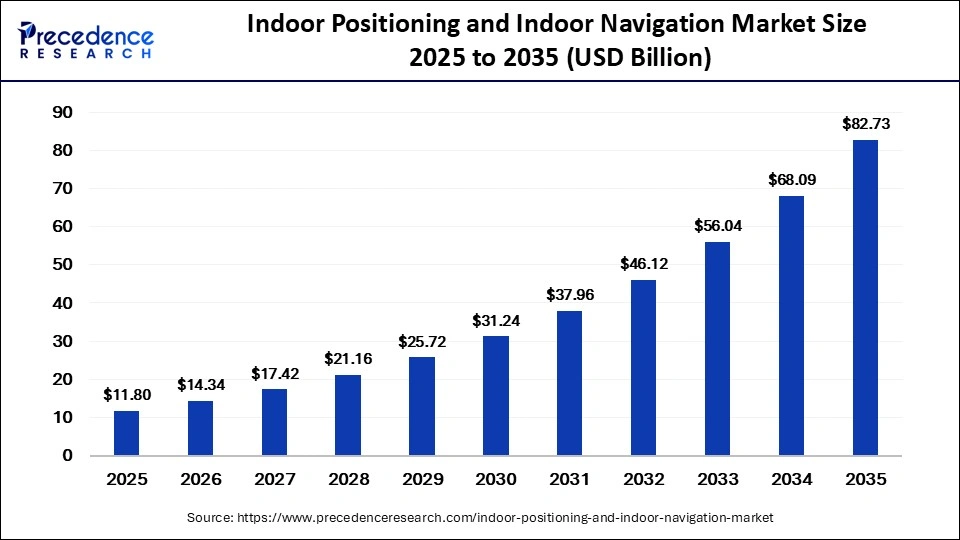
This growth is fueled by the rising demand for accurate indoor tracking, smart infrastructure development, and enhanced user experiences across industries such as retail, healthcare, logistics, and transportation.
Read Also: Marketing Automation Software Market
What is Indoor Positioning and Indoor Navigation?
Indoor positioning and navigation systems (IPIN) enable precise tracking and navigation within enclosed environments such as airports, hospitals, shopping malls, warehouses, and office buildings.
Unlike GPS, which is designed for outdoor use, indoor positioning relies on technologies such as:
- Wi-Fi positioning systems
- Bluetooth Low Energy (BLE) beacons
- Ultra-wideband (UWB)
- Radio Frequency Identification (RFID)
These systems help organizations improve operational efficiency, optimize asset management, and deliver seamless navigation experiences.
Key Market Drivers
1. Growth of Smart Buildings and Smart Cities
The rise of smart infrastructure is significantly boosting demand for indoor positioning solutions. These systems are essential for managing connected environments and improving operational efficiency.
2. Increasing Demand for Real-Time Asset Tracking
Industries such as healthcare, manufacturing, and logistics rely on indoor positioning to track equipment, inventory, and personnel in real time.
3. Enhanced Customer Experience in Retail
Retailers are using indoor navigation for personalized promotions, in-store navigation, and customer behavior analytics to improve engagement and sales.
Latest Market Trends
Integration of AI and IoT
Artificial intelligence and IoT are enhancing indoor positioning systems by enabling predictive analytics, automation, and intelligent decision-making.
Rising Adoption of BLE Beacons and UWB
BLE beacons are widely adopted due to their cost-effectiveness, while UWB is gaining traction for high-precision tracking in industrial and healthcare applications.
Expansion of Location-Based Marketing
Businesses are leveraging indoor positioning systems to deliver targeted, real-time promotions based on user location.
Increasing Use in Safety and Emergency Response
Indoor navigation systems are being deployed for emergency management, enabling faster evacuation and improved safety in critical situations.
Market Segmentation Insights
By Technology
- Wi-Fi positioning systems dominate due to widespread infrastructure availability.
- BLE beacons are the fastest-growing segment.
- UWB is increasingly used for high-accuracy applications.
By Component
- Hardware leads the market, driven by demand for sensors, beacons, and tags.
- Software solutions are growing rapidly due to analytics and mapping capabilities.
By Application
- Asset tracking and inventory management hold the largest share.
- Indoor navigation and wayfinding are widely used in large facilities.
- Proximity marketing is the fastest-growing segment.
By End-Use Industry
- Retail dominates due to high adoption for customer engagement.
- Healthcare is the fastest-growing sector, driven by patient and asset tracking needs.
Regional Analysis
North America Leads the Market
North America holds the largest share, supported by advanced digital infrastructure and early adoption of smart technologies.
Asia Pacific Shows Fastest Growth
Asia Pacific is expected to grow at the fastest rate due to rapid urbanization, smart city initiatives, and increasing digital transformation in countries such as India and China.
Challenges in the Market
Despite strong growth, the market faces several challenges:
- High infrastructure and deployment costs
- Data privacy and cybersecurity concerns
- Integration complexities with existing systems
These challenges may limit adoption, especially in cost-sensitive regions.
Opportunities and Future Outlook
The future of indoor positioning and navigation lies in advanced analytics, AI-driven automation, and integration with smart infrastructure. Key opportunities include:
- Expansion of smart buildings and connected ecosystems
- Integration with IoT platforms and digital twins
- Growth in real-time location-based services
As businesses continue to focus on operational efficiency and customer experience, indoor positioning systems are expected to become a core component of digital transformation strategies.
Conclusion
The indoor positioning and indoor navigation market is evolving rapidly, driven by technological advancements and increasing demand for real-time location intelligence.
With strong growth projections and expanding applications across industries, these systems are set to play a crucial role in shaping the future of smart environments. Organizations that invest in indoor positioning technologies today will be better positioned to enhance efficiency, improve user experiences, and stay competitive in the digital era.
Get Sample Copy: https://www.precedenceresearch.com/sample/8355
For inquiries regarding discounts, bulk purchases, or customization requests, please contact us at sales@precedenceresearch.com
