
 by
by The global gene amplification technology market is witnessing steady growth as healthcare systems, research institutions, and biotechnology companies increasingly rely on advanced molecular diagnostic tools. The market is projected to grow from USD 3.99 billion in 2026 to approximately USD 10.04 billion by 2035, expanding at a CAGR of 10.8%.
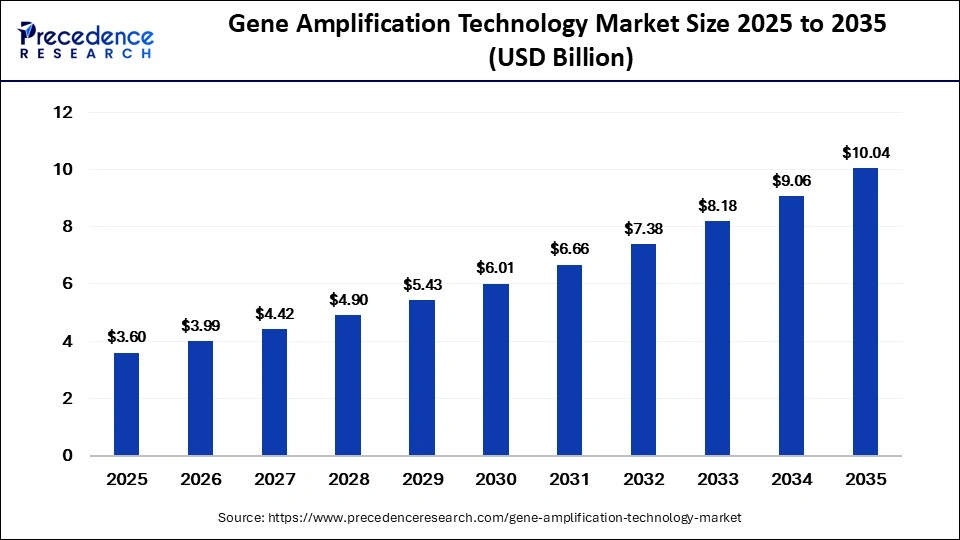
This growth underscores the growing importance of gene amplification technologies in enabling accurate, rapid, and scalable genetic analysis across clinical diagnostics, life sciences research, and drug development.
Read Also: Indoor Positioning and Indoor Navigation Market
What is Gene Amplification Technology?
Gene amplification technology refers to molecular biology techniques used to replicate specific DNA or RNA sequences, allowing detection and analysis even from very small genetic samples.
Commonly used technologies include:
- Polymerase Chain Reaction (PCR)
- Digital PCR (dPCR)
- Isothermal amplification methods (LAMP, NASBA, RPA)
- Rolling Circle Amplification (RCA)
- Multiple Displacement Amplification (MDA)
These techniques play a critical role in disease detection, genetic research, forensic analysis, and pharmaceutical development.
Key Market Drivers
1. Rising Demand for Precision Medicine
The shift toward personalized healthcare is driving adoption of gene amplification technologies, enabling targeted therapies and improved patient outcomes.
2. Increasing Prevalence of Infectious and Chronic Diseases
The growing burden of diseases such as cancer and infectious conditions is accelerating demand for accurate and rapid diagnostic tools.
3. Expansion of Genomics and Biotechnology Research
Rising investments in genomics, molecular biology, and drug discovery are boosting demand for advanced gene amplification solutions.
Latest Market Trends
Integration of AI and Automation
Artificial intelligence is improving data analysis and enabling automated workflows, enhancing efficiency and reducing human error in laboratory processes.
Growth of Isothermal Amplification
Technologies such as LAMP and NASBA are gaining traction due to their speed, cost-effectiveness, and suitability for point-of-care diagnostics.
Advancements in PCR Technologies
Innovations in real-time PCR and digital PCR are improving sensitivity, accuracy, and quantification capabilities.
Market Segmentation Insights
By Technology
- PCR dominates the market due to its high accuracy and widespread adoption.
- Isothermal amplification is the fastest-growing segment.
- Digital PCR is gaining traction for high-precision applications.
By Product Type
- Reagents and kits hold the largest share due to recurring demand.
- Instruments such as thermal cyclers are essential for amplification processes.
- Consumables support routine laboratory operations.
By Application
- Clinical diagnostics dominate the market.
- Research and academic applications continue to grow steadily.
- Drug discovery and forensic testing are emerging areas.
By End-Use
- Hospitals and diagnostic laboratories lead adoption.
- Academic and research institutes play a significant role.
- Pharmaceutical and biotechnology companies are rapidly expanding usage.
Regional Analysis
North America Leads the Market
North America holds the largest share due to advanced healthcare infrastructure, strong research capabilities, and early adoption of molecular diagnostics technologies.
Asia Pacific Shows Fastest Growth
Asia Pacific is expected to grow at the fastest rate due to expanding healthcare systems, increasing research activities, and rising biotechnology investments in countries such as India and China.
Challenges in the Market
Despite strong growth potential, the market faces several challenges:
- High cost of equipment and reagents
- Complex regulatory requirements
- Ethical and data privacy concerns related to genetic data
These factors may limit adoption, particularly in developing regions.
Opportunities and Future Outlook
The gene amplification technology market offers significant opportunities driven by innovation and increasing demand for advanced diagnostics. Key opportunities include:
- Expansion of point-of-care testing solutions
- Integration of AI and data analytics
- Growth in oncology and infectious disease diagnostics
- Development of high-throughput and automated testing systems
As healthcare systems continue to evolve, gene amplification technologies are expected to play a pivotal role in enabling faster, more accurate, and scalable diagnostics.
Conclusion
The gene amplification technology market is becoming a cornerstone of modern healthcare and biotechnology innovation.
With strong growth projections, advancements in molecular diagnostics, and increasing adoption of precision medicine, the market is set to expand significantly over the coming years. Organizations investing in advanced gene amplification technologies will be well-positioned to drive innovation, improve patient outcomes, and lead in the evolving landscape of life sciences.
Read Also: Marketing Automation Software Market
For inquiries regarding discounts, bulk purchases, or customization requests, please contact us at sales@precedenceresearch.com
