
 by
by 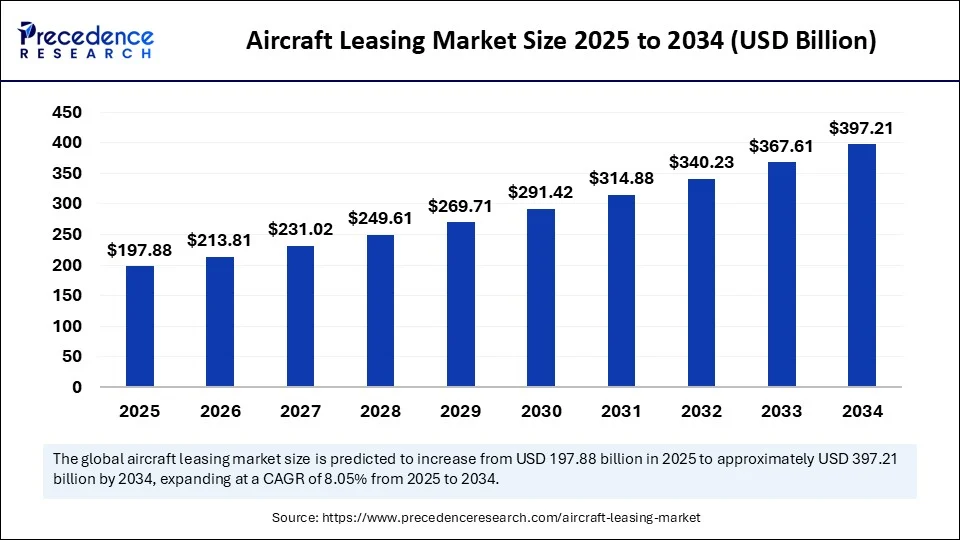
Aircraft Leasing Market Key Takeaways
- In terms of revenue, the global aircraft leasing market was valued at USD 183.13 billion in 2024.
- It is projected to reach USD 397.21 billion by 2034.
- The market is expected to grow at a CAGR of 8.05 % from 2025 to 2034.
- North America dominated the aircraft leasing market with the largest share of 41% in 2024.
- Asia Pacific is expected to grow at the fastest CAGR from 2025 to 2034.
- By lease type, the dry lease segment held the major market share in 2024.
- By lease type, the wet lease segment is projected to grow at a significant CAGR between 2025 and 2034.
- By aircraft type, the narrow-body segment contributed the biggest market share in 2024.
- By aircraft type, the wide-body segment is expected to grow at a significant CAGR between 2025 and 2034.
- By lease term, the long-term leases segment led the market in 2024.
- By lease term, the short-term leases segment is expected to grow at the highest CAGR over the projected period.
- By lessee type, the commercial airlines segment captured the biggest market share in 2024.
- By lessee type, the cargo operators segment is expected to grow at the fastest CAGR from 2025 to 2034.
Impact of Artificial Intelligence on the Aircraft Leasing Market
Artificial Intelligence (AI) is increasingly shaping the aircraft leasing industry by enabling data-driven decision-making and enhancing operational efficiency. Leading leasing firms are leveraging AI-powered tools to analyze aircraft performance metrics, optimize lease structures, and accurately forecast market demand.
Machine learning algorithms are now replacing traditional financial models to predict residual aircraft value, allowing companies to better assess asset risk and make more informed investment decisions. AI also strengthens portfolio management by providing real-time insights into key operational indicators such as flight hours, fuel consumption, and utilization trends.
Furthermore, AI plays a critical role in predictive maintenance, helping identify wear patterns and potential failures in aircraft components before issues arise. This proactive approach minimizes unscheduled downtime, improves aircraft availability, and ultimately boosts the overall reliability of leased fleets.
Market Overview
The high demand, driven by the need to increase fleet size at a low cost and with flexibility in operations, has seen the aircraft leasing industry grow exponentially. Airlines in various parts of the world are finding ways to modernize their fleets at a low cost. Aircraft leasing occurs when airlines take aircraft on a lease basis rather than purchasing them directly through a leasing company. This model comprises dry leases (aircraft alone) and wet leases (aircraft, operation, maintenance, and insurance) to enable operators to match their fleet operations to their short- and long-term business needs among lessors offering narrow- and wide-body aircraft, as lessees increased their demands, particularly for the Airbus A320neo and Boeing 787. Furthermore, the need to accommodate short-term demand, rising cargo operations, and the adoption of short-term leasing by regional airlines have also been touted as drivers of further market growth.
Driver
How Is Soaring Air Travel in Emerging Markets Reshaping the Aircraft Leasing Landscape?
The surge in air travel demand across emerging markets is significantly influencing the growth and evolution of the aircraft leasing industry. As airlines in these regions seek to expand their fleets rapidly, leasing presents a cost-effective and flexible alternative to direct aircraft purchases—eliminating the need for substantial upfront capital and long manufacturing lead times.
Regions such as Asia-Pacific, the Middle East, and Africa are experiencing a sharp rise in passenger volumes. According to the International Air Transport Association (IATA), international air traffic reached 99.1% of 2019 levels in 2024, with the Asia-Pacific region recording a 92.6% year-over-year increase in international demand—leading all global regions.
Leasing companies are responding by expanding their regional presence and offering more adaptable lease terms to support fast-growing carriers. For instance, AerCap announced expectations of a notable increase in lease placements across India and Southeast Asia, where operators are eager to access new-generation aircraft without the burden of ownership.
Additionally, the rising number of air operators in these markets reflects their growing reliance on lease-backed fleet expansion, underscoring the leasing sector’s critical role in enabling aviation growth across emerging economies.
Also Read: Aircraft MRO Market
Aircraft Leasing Market Companies
- AerCap (GECAS)
- Air Lease Corporation
- Avolon
- BBAM
- BOC Aviation
- Boeing Capital Corporation
- DAE Capital
- ICBC Leasing
- Nordic Aviation Capital
- SMBC Aviation Capita
Latest Announcement by Industry Leader
- In June 2025, Volato Group, Inc., a technology-focused private aviation company, introduced a new aircraft leasing initiative aimed at placing high-demand jets with third-party operators. This strategy is designed to create a recurring, asset-light revenue model by leveraging Volato’s transaction expertise and expanding its ecosystem of aviation partners and software users. The announcement comes just ahead of the company’s scheduled participation in the Jefferies Virtual Business Aviation Summit on June 5, 2025, where Co-Founder and CEO Matt Liotta will provide further insight into the leasing strategy and broader platform evolution. “We’re not just leasing aircraft—we’re building an infrastructure layer for the industry,” said Liotta. “By connecting supply, demand, and technology more intelligently, we’re unlocking value that traditional models leave on the table.” The new model seeks to capitalize on the projected 11% growth in business aircraft aviation demand in 2025, as operators and travelers increasingly shift toward more agile, technology-integrated solutions. Volato’s approach reflects a growing trend across the sector, prioritizing flexibility, efficiency, and platform-based innovation.
