
 by
by The global AI data center power consumption market is witnessing exponential growth as artificial intelligence workloads become increasingly complex and compute-intensive. The market size was valued at USD 12.50 billion in 2025 and is projected to grow from USD 14.86 billion in 2026 to USD 70.59 billion by 2035, expanding at a robust CAGR of 18.90% during the forecast period.
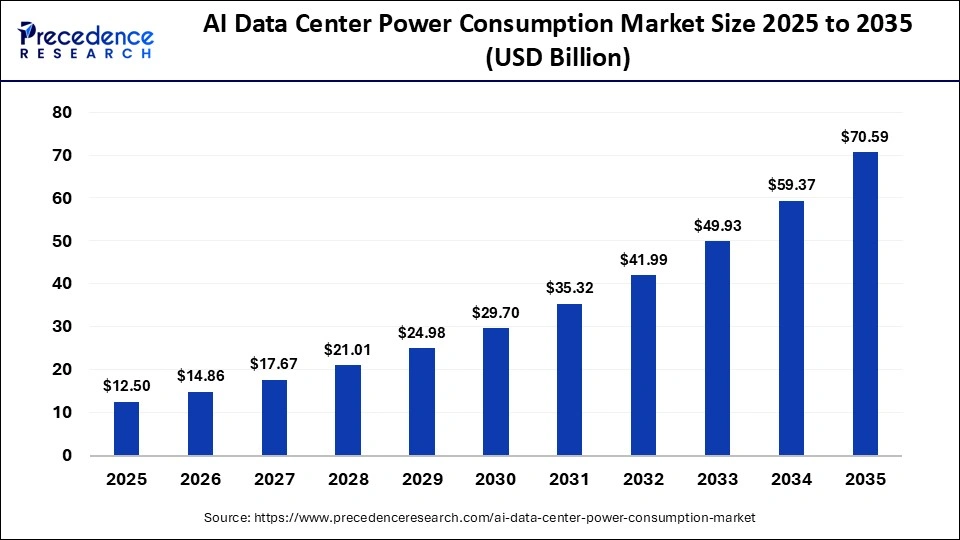
This rapid expansion is fueled by the widespread adoption of generative AI, machine learning, and high-performance computing (HPC). As organizations deploy large language models and AI-driven applications, data centers are experiencing a dramatic surge in power consumption, making energy efficiency a critical priority.
Read Also: Fiber Optic Cable Market
Quick Insights: What Defines the Market Landscape?
The AI data center power consumption market is characterized by rapidly increasing electricity demand driven by high-density GPU workloads and AI training operations. North America dominates the market with a leading share of approximately 42%, supported by advanced cloud infrastructure and hyperscale investments. Asia Pacific is emerging as the fastest-growing region with a projected CAGR of over 21%, fueled by digital transformation and AI adoption. Cooling systems represent the largest component segment with around 30% share, followed by UPS systems at 25%. Hyperscale data centers lead by type with a dominant 45% share, while AI training workloads account for the highest application share of 35%. The IT & telecommunications sector remains the largest end-use segment, contributing approximately 35% of the total market.
How is AI Transforming Data Center Power Consumption?
Artificial intelligence is fundamentally reshaping the energy dynamics of data centers. AI workloads, particularly those involving deep learning and large language models, require significantly higher computational power compared to traditional applications. This has led to the deployment of high-density GPU clusters and specialized accelerators, dramatically increasing electricity consumption.
At the same time, AI is being used to optimize energy usage within data centers. Intelligent power management systems, predictive analytics, and AI-driven cooling solutions are helping operators reduce inefficiencies, improve thermal management, and enhance overall energy performance. This dual role of AI—as both a driver and optimizer of power consumption—is central to the evolution of the market.
What are the Key Growth Drivers of the Market?
The primary growth driver is the surging demand for generative AI and large-scale model training, which requires immense computational resources and energy.
Additionally, the rapid expansion of hyperscale data centers and cloud computing infrastructure is significantly contributing to rising power consumption. Industries such as BFSI, healthcare, and telecommunications are increasingly relying on AI-driven analytics, automation, and real-time processing, further accelerating demand.
Another major factor is the growing need for low-latency, high-performance computing environments, which require continuous and uninterrupted power supply, pushing investments in advanced power infrastructure.
What Opportunities and Trends are Shaping the Market?
Is Liquid Cooling Becoming Essential for AI Data Centers?
Yes, liquid cooling technologies are rapidly gaining traction as they offer higher efficiency compared to traditional air cooling. With AI workloads generating significant heat, advanced cooling systems are becoming essential for maintaining performance and reducing energy waste.
Will Renewable Energy Power the Future of AI Infrastructure?
There is a growing shift toward renewable and low-carbon energy sources such as solar and wind. Data center operators are increasingly aligning with sustainability goals and ESG commitments to reduce carbon footprints.
Are Hyperscale Data Centers Driving Energy Demand?
Absolutely. Hyperscale data centers dominate the market due to their ability to handle massive AI workloads. Their rapid expansion is significantly increasing total energy consumption across regions.
Regional Analysis: Where is Growth Concentrated?
North America leads the global market, driven by the presence of major cloud providers and advanced AI ecosystems. The region benefits from strong investments in hyperscale infrastructure and cutting-edge technologies.
Asia Pacific is expected to register the fastest growth, supported by increasing AI adoption, expanding data center infrastructure, and government initiatives promoting digital transformation. Europe is also witnessing steady growth, with a strong focus on sustainability and energy-efficient operations.
Segmental Analysis: Understanding Market Dynamics
Component Insights
Cooling systems dominate the market with a 30% share, driven by the need to manage heat from high-density AI workloads. UPS systems hold a significant share of 25%, ensuring uninterrupted operations in mission-critical environments.
Data Center Type Insights
Hyperscale data centers lead with a 45% share due to large-scale AI deployments, followed by colocation data centers, which are gaining traction as enterprises outsource infrastructure needs.
Application Insights
AI training workloads dominate the market with a 35% share, reflecting the high energy demands of developing complex AI models. Generative AI and LLMs are expected to grow at the fastest rate during the forecast period.
End-Use Industry Insights
The IT & telecommunications sector leads with a 35% share, followed by BFSI and healthcare, both of which are rapidly adopting AI technologies.
Competitive Landscape: Key Players Driving Innovation
The market is highly competitive, with leading technology companies investing heavily in energy-efficient infrastructure and advanced cooling solutions.
Key players include:
- Amazon Web Services (AWS)
- Microsoft Corporation
- Google LLC
- NVIDIA Corporation
- Intel Corporation
- IBM Corporation
- Equinix Inc.
- Digital Realty
- Schneider Electric
These companies are focusing on innovation in power management, renewable energy integration, and AI-optimized infrastructure to address rising energy demands.
Recent Developments and Breakthroughs
Recent industry developments highlight the growing focus on energy optimization. Advanced AI-powered systems are enabling real-time power adjustments, improving grid stability and reducing peak load pressures. Additionally, innovations in chip design and cooling technologies are helping improve energy efficiency in high-performance computing environments.
Challenges and Cost Pressures
Despite strong growth, the market faces challenges such as rising electricity costs and infrastructure investments. AI data centers consume significantly more power than traditional facilities, putting pressure on energy grids and increasing operational expenses.
Managing heat generation and ensuring efficient cooling also remain critical challenges, requiring continuous innovation in thermal management technologies.
Case Study: Optimizing Energy Efficiency in Hyperscale Data Centers
A leading hyperscale operator implemented AI-driven power management and liquid cooling systems across its data centers. This resulted in improved energy efficiency, reduced operational costs, and enhanced system performance, demonstrating the potential of integrating advanced technologies with sustainable practices.
Download a Free Sample PDF: https://www.precedenceresearch.com/sample/8318
For inquiries regarding discounts, bulk purchases, or customization requests, please contact us at [email protected]
