
 by
by 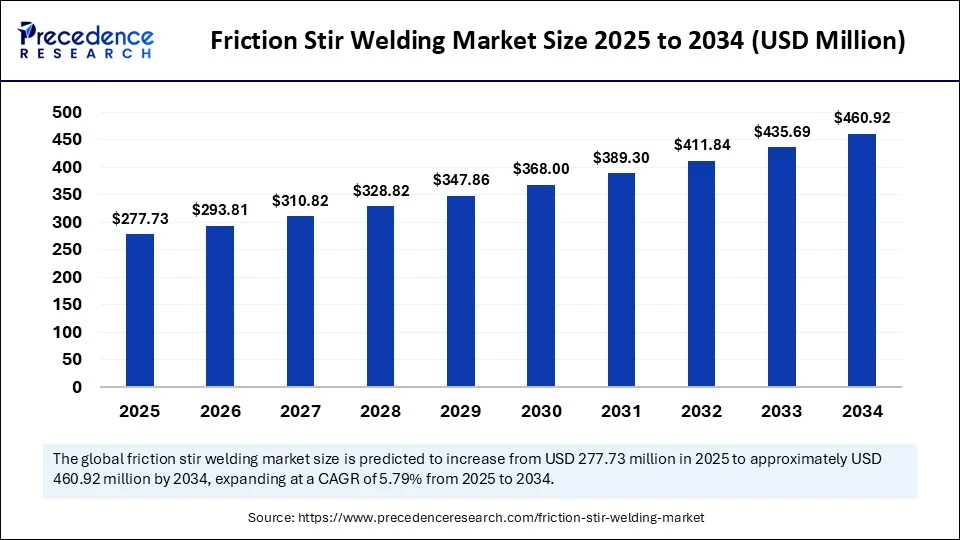
Friction Stir Welding Market Key Takeaways
- In terms of revenue, the global friction stir welding market was valued at USD 262.53 million in 2024.
- It is projected to reach USD 460.92 million by 2034.
- The market is expected to grow at a CAGR of 5.79% from 2025 to 2034.
- North America dominated the global friction stir welding market with the largest share of 36% in 2024.
- Asia Pacific is expected to grow at a notable CAGR from 2025 to 2034.
- By equipment type, the fixed FSW equipment segment held the major market share of 41% in 2024.
- By equipment type, the portable FSW equipment segment is projected to grow at a CAGR between 2025 and 2034.
- By material type, the aluminium alloy segment contributed the biggest market share of 53% in 2024.
- By material type, the steel & stainless steel segment is expanding at a significant CAGR between 2025 and 2034.
- By end use industry, the automotive & transportation segment captured the highest market share of 32% in 2024.
- By end use industry, the aerospace & defense segment is expected to grow at a significant CAGR over the projected period.
- By technology/ tool type, conventional FSW tools segment led the market in 2024.
- By technology/tool type, the advanced tool materials segment is expected to grow at a notable CAGR from 2025 to 2034.
- By automation level, fully automated & CNC-integrated systems dominated the global market in 2024, and is expected to sustain the growth in the coming years.
Impact of Artificial Intelligence on the Friction Stir Welding Market
Manufacturers are increasingly adopting AI-powered applications to monitor real-time welding data such as tool position, heat input, and material flow. This helps maintain consistent weld quality with reduced reliance on manual intervention. Additionally, machine learning models enable the detection of anomalies during the welding process, allowing for immediate corrective actions. This not only minimizes rework but also enhances the overall reliability of the final product.
Market Overview
The Friction Stir Welding (FSW) market centers on a solid-state joining technique in which materials are fused without reaching their melting point. This is achieved by applying frictional heat and mechanical stirring using a non-consumable rotating tool. FSW is particularly effective for joining aluminum, magnesium, copper, and dissimilar materials, offering key advantages such as minimal distortion, high weld strength, no filler requirement, and environmentally friendly operations.
FSW is gaining traction across industries such as aerospace, automotive, shipbuilding, railways, defense, and electronics due to the growing demand for lightweight and high-strength structures. The process supports modern engineering needs, especially in sectors where material integrity and performance are critical.
The rising need for lightweight materials in automotive and aerospace sectors continues to fuel FSW market growth. In 2024, the U.S. Department of Energy emphasized the importance of lightweight structural materials to meet national fuel economy targets and clean transportation goals. FSW plays a vital role in this initiative by enabling high-integrity welds in electric vehicle battery enclosures, aerospace fuselages, and high-speed rail components.
Additionally, the increasing emphasis on energy-efficient and low-emission manufacturing systems is expected to further accelerate the adoption of FSW in advanced industrial applications.
Friction Stir Welding Market Growth Factors
- Rising Demand for High-Speed Rail Infrastructure: As global investments in sustainable, lightweight, and durable transportation grow, friction stir welding is increasingly adopted in the manufacture of railcars and high-speed rail systems. Its ability to produce strong, defect-free joints supports the structural integrity and efficiency required in modern rail networks.
- Increased Use of Aluminum in Shipbuilding: The marine industry is turning to FSW to meet the rising demand for corrosion-resistant, high-strength aluminum joints in ship hulls and superstructures. This shift is enhancing manufacturing capabilities in naval and commercial shipbuilding, where performance and durability are mission-critical.
- Growing Adoption in Cryogenic Tank Fabrication: The demand for high-integrity, leak-proof welds in liquefied natural gas (LNG) and hydrogen storage tanks is driving the application of FSW in the energy sector. Its solid-state nature makes it ideal for cryogenic environments where weld quality and material behavior are crucial.
- Expanding Use in Spacecraft Component Assembly: Leading space agencies such as NASA and the European Space Agency (ESA) are leveraging friction stir welding for satellite structures and launch vehicle assemblies. The process provides exceptional weld reliability and strength, critical for withstanding the extreme conditions of space missions.
Drivers
Rising Demand for Lightweight Materials in Automotive and Aerospace Sectors
The increasing emphasis on weight reduction in the automotive and aerospace industries is significantly accelerating the adoption of friction stir welding technology. Unlike traditional fusion welding, FSW is a solid-state process that joins materials without melting them, making it ideal for lightweight, non-ferrous metals such as aluminum and magnesium alloys. This leads to stronger joints, enhanced fatigue resistance, minimal distortion, and improved structural integrity—key advantages for high-performance applications.
Automotive OEMs are investing heavily in lightweight materials to improve fuel efficiency and comply with stringent emission regulations. Meanwhile, aerospace manufacturers are leveraging FSW to enhance payload efficiency and reduce structural weight. The U.S. Department of Energy’s 2024 report recognized aluminum alloys as a cornerstone of vehicle mass reduction strategies under its sustainable transportation agenda.
Additionally, the American Welding Society (AWS) highlighted in 2024 that North American automotive OEMs have increasingly adopted solid-state welding techniques for their superior weld quality and cost-effectiveness. The industry-wide shift toward precision joining and structural optimization continues to position FSW as a pivotal technology for lightweight manufacturing.
Restraint
Limited Material Compatibility Restricts Broader Industrial Application
While friction stir welding offers numerous advantages, its applicability is largely confined to soft, non-ferrous materials such as aluminum and magnesium alloys. This material limitation presents a key barrier to widespread industrial adoption—particularly in sectors that require welding of harder ferrous metals like steel or titanium.
Although research institutions such as the Fraunhofer Institute are exploring advanced tool materials to expand FSW’s range to high-temperature alloys and harder metals, commercial scalability remains a challenge. Moreover, the high initial investment in specialized FSW equipment—both in terms of cost and infrastructure—makes it less feasible for small and mid-sized enterprises. These factors collectively restrain market growth.
Opportunity
Surging Demand for Thermally Stable Joints in Electric Vehicle Battery Assemblies
The rapid growth of the electric vehicle (EV) sector presents a major opportunity for friction stir welding, particularly in the production of battery enclosures and related assemblies. EV manufacturers require highly durable and thermally stable joints for battery trays, housings, and support structures—needs that FSW is uniquely positioned to meet.
FSW enables the creation of robust, conductive, and defect-free joints in materials like aluminum, without compromising electrical performance or introducing thermal stress. The process minimizes the heat-affected zone, which is critical for thermal management in sensitive battery environments. As a result, leading EV manufacturers across Europe, China, and the U.S. are increasingly integrating FSW into battery production lines.
Recent Developments
- In October 2024, TWI Ltd and Stirweld announced a collaborative event to showcase advanced tank welding capabilities using Stirweld’s retractable pin Friction Stir Welding (FSW) head technology. Supported by the UK Aerospace Technology Institute (ATI) MASTER project, the event is scheduled for March 11, 2025, at TWI Ltd’s Cambridge facility. Live welding demonstrations and expert talks from key stakeholders, including GKN Aerospace, will highlight innovations in manufacturing aluminium hydrogen storage tanks for aerospace applications.
- In April 2025, Bodor officially launched its ECO Series handheld laser welding machine, offering full-rated power and higher welding speeds. The system is designed to reduce labor costs by up to 50%, while delivering smart, automation-ready performance for next-generation manufacturing environments.
- In May 2024, IPG Photonics Corporation (NASDAQ: IPGP), a global leader in fiber laser solutions, introduced an automated cobot laser welding and cleaning system tailored for fabrication and manufacturing sectors. The system supports streamlined, high-precision operations, reinforcing IPG’s position at the forefront of advanced welding automation.
Friction Stir Welding Market Companies
- Achi Industries Co., Ltd.
- Beijing FSW Technology Co., Ltd.
- Bharat Heavy Electricals Limited (BHEL, India)
- ESAB (Colfax Corporation)
- ETA Technology Pvt. Ltd. (India)
- Fronius International GmbH
- Gatwick Technologies
- General Tool Company
- Grenzebach Maschinenbau GmbH
- HFW Solutions
- Hitachi High-Tech Corporation
- IWES GmbH
- KUKA Systems GmbH
- Mazak Corporation
- MTI (Manufacturing Technology Inc.)
- PaR Systems, LLC
- Stirtec GmbH
- Thyssenkrupp AG
- TWI Ltd (The Welding Institute, UK)
- VBC Group (UK)
