
 by
by What is the Inline Metrology Market Size in 2026?
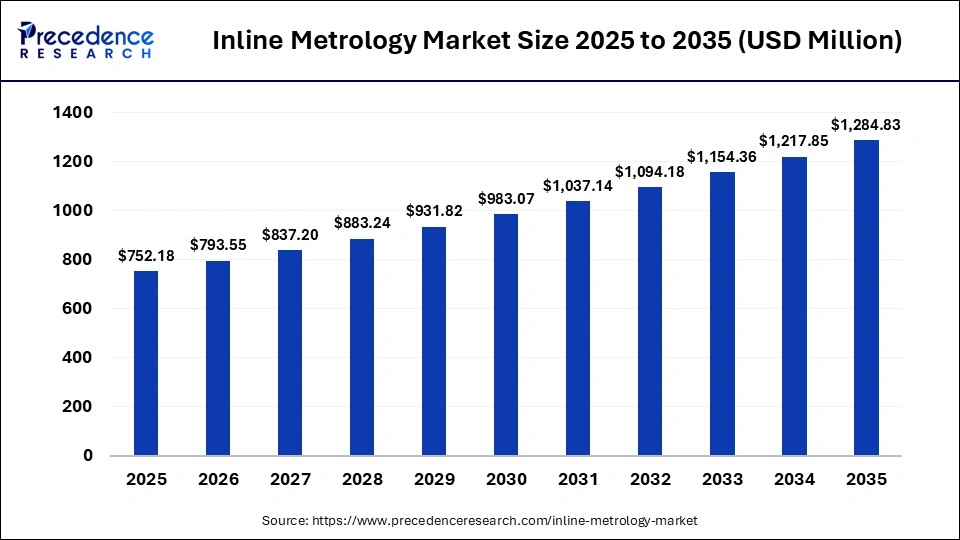
The global inline metrology market size was valued at USD 752.18 million in 2025 and is projected to grow from USD 793.55 million in 2026 to approximately USD 1,284.83 million by 2035, expanding at a CAGR of 5.50% from 2026 to 2035.
The market is growing due to the rising demand for real-time quality control, high-speed manufacturing processes, and the increasing adoption of automation technologies across the automotive and electronics industries. Inline metrology systems help manufacturers monitor product quality directly on production lines, reducing defects, minimizing waste, and improving production efficiency.
Read Also: MXene Market
Inline Metrology Market Overview
The inline metrology market includes advanced measurement technologies used directly on production lines to inspect and verify components during manufacturing. Unlike traditional inspection methods that check products after production, inline metrology systems perform real-time measurements during the manufacturing process, enabling manufacturers to detect defects early and maintain consistent product quality.
These systems typically include technologies such as:
-
Coordinate measuring machines (CMMs)
-
Machine vision systems
-
Optical scanners
-
Laser-based measurement tools
By integrating these systems into automated production lines, manufacturers can reduce scrap, improve product accuracy, and accelerate manufacturing throughput. The adoption of Industry 4.0 practices and smart manufacturing systems is further accelerating the demand for inline metrology solutions across industries such as automotive, aerospace, electronics, and medical devices.
Role of Artificial Intelligence in the Inline Metrology Market
Artificial intelligence is transforming inline metrology by enabling smarter inspection, predictive maintenance, and automated decision-making during production.
AI-driven algorithms analyze large volumes of production data in real time, detecting even minor deviations that may indicate potential defects. This capability allows manufacturers to adjust machine parameters instantly, preventing large-scale quality issues.
Key benefits of AI integration in inline metrology include:
-
Real-time defect detection
-
Predictive maintenance of inspection equipment
-
Improved measurement accuracy
-
Reduced downtime and production delays
In high-speed industries such as automotive and semiconductor manufacturing, AI-powered inline metrology ensures high precision inspection without slowing down production lines.
Key Trends in the Inline Metrology Market
Adoption of Real-Time Quality Control
Manufacturers are increasingly adopting inline metrology solutions to support continuous quality monitoring and zero-defect production strategies. Real-time inspection helps companies reduce product recalls, minimize rework, and improve overall manufacturing efficiency.
Integration of AI and Automation
The integration of artificial intelligence and automation technologies is enhancing the capabilities of inline metrology systems. AI-based analytics tools can quickly process measurement data, enabling faster decision-making and improved production optimization.
Growing Demand for Optical and Laser Measurement Systems
Technological advancements are driving demand for high-speed optical scanners, laser-based inspection systems, and advanced vision technologies that can capture accurate measurements without interrupting production processes.
Investment in Smart Manufacturing Technologies
Companies are increasingly investing in inline metrology as part of their smart factory initiatives, aiming to enhance productivity while maintaining strict quality standards.
Inline Metrology Market Segment Analysis
Product Type Insights
Coordinate Measuring Machines (CMMs)
The coordinate measuring machines (CMMs) segment held the largest market share of around 40% in 2025. CMM systems are widely used for measuring complex geometries and maintaining tight dimensional tolerances in industries such as automotive, aerospace, and industrial manufacturing.
These systems offer high precision and consistent measurement performance, making them ideal for large-scale production environments. Modern CMM systems are increasingly integrated with automation platforms, allowing measurement data to be directly transferred into manufacturing systems for faster decision-making.
Machine Vision Systems
The machine vision systems segment is expected to grow at the fastest CAGR of 4.3% during the forecast period.
Machine vision technologies use cameras and advanced image processing software to inspect components without interrupting production. These systems are particularly effective in detecting surface defects, alignment issues, and assembly errors in high-volume manufacturing environments.
Industries such as electronics manufacturing, packaging, and semiconductor production increasingly rely on machine vision systems due to their speed, flexibility, and accuracy.
Industry Vertical Insights
Automotive Industry
The automotive segment dominated the inline metrology market with a share of approximately 35% in 2025.
Automobile manufacturing involves thousands of components that must be assembled with precise tolerances. Inline metrology systems are widely used across body assembly lines, electronic component production, and final vehicle inspection stages.
By integrating measurement technologies directly into production lines, automotive manufacturers can detect defects early, reducing scrap and preventing costly recalls.
Electronics and Semiconductors
The electronics and semiconductors segment is expected to grow at the fastest CAGR of 4.7% during the forecast period.
Manufacturing printed circuit boards, connectors, and semiconductor devices requires extremely precise measurement and alignment. Even small variations can affect device performance.
Inline metrology systems allow manufacturers to monitor alignment accuracy, pattern consistency, and surface quality in real time, preventing defects and improving production yields.
Offering Insights
Hardware
The hardware segment accounted for the largest share of around 60% in 2025.
Hardware components include measurement systems such as:
-
Coordinate measuring machines
-
Laser scanners
-
Optical sensors
-
Contact and non-contact probing devices
These systems capture dimensional and surface data directly on the production line, allowing manufacturers to monitor quality without slowing production.
Software
The software segment is expected to grow at the fastest CAGR of 4.9% during the forecast period.
Inline metrology software converts measurement data into actionable insights by analyzing production performance and identifying deviations. Advanced software platforms integrate seamlessly with ERP, MES, and industrial automation systems, enabling better process monitoring and data-driven decision-making.
Application Insights
Quality Control and Inspection
The quality control and inspection segment held the largest share of around 50% in 2025.
Inline metrology enables manufacturers to monitor dimensions, surface quality, and positioning of components during production, allowing them to detect issues early and maintain high-quality output.
Industries such as aerospace, automotive, and industrial manufacturing rely heavily on these systems to meet strict quality standards.
Reverse Engineering
The reverse engineering segment is expected to grow rapidly with a CAGR of 4.5% during the forecast period.
Reverse engineering involves capturing detailed geometric data from existing components and converting them into digital models. Inline measurement technologies significantly reduce the time required to capture this data, enabling faster product redesign and development.
Regional Insights
Asia Pacific
Asia Pacific dominated the inline metrology market in 2025 with a revenue share of approximately 35% and is expected to grow at the fastest CAGR of 5.8% during the forecast period.
The region benefits from a strong manufacturing base and rapid industrial expansion, particularly in automotive, electronics, and semiconductor production.
Countries contributing significantly to market growth include:
-
China
-
India
-
Japan
-
South Korea
China Market Trends
China represents the largest inline metrology market in Asia Pacific due to its large-scale manufacturing ecosystem. Manufacturers are increasingly integrating measurement systems into production lines to maintain product quality and meet international standards.
Companies such as Nikon Metrology and KEYENCE Corporation are expanding their presence in the region to support growing demand.
North America
North America is expected to witness significant growth between 2026 and 2035 due to advancements in manufacturing technologies and the increasing adoption of automation.
The United States plays a major role in market growth, supported by strong demand from industries such as aerospace, automotive, defense, and semiconductor manufacturing.
Leading companies driving innovation in the region include:
-
Hexagon AB
-
FARO Technologies
-
KLA Corporation
Europe
Europe is also experiencing steady growth in the inline metrology market due to increasing demand for precision measurement tools in the automotive and aerospace sectors.
Countries such as Germany, France, and Italy are heavily investing in advanced manufacturing technologies and automated quality control systems.
Competitive Landscape
The inline metrology market is highly competitive, with leading companies focusing on innovation, automation integration, and high-precision measurement technologies.
Key companies operating in the market include:
-
Hexagon AB
-
Carl Zeiss AG
-
KLA Corporation
-
KEYENCE Corporation
-
Mitutoyo Corporation
-
FARO Technologies
-
Renishaw plc
-
Jenoptik AG
-
Cognex Corporation
-
Intertek Group plc
For inquiries regarding discounts, bulk purchases, or customization requests, please contact us at [email protected]
