
 by
by The global multilingual LLM market is projected to hit USD 57 billion by 2035, driven by generative AI adoption, multilingual customer support demand, sovereign AI initiatives, and rapid growth in non-English digital economies.
Multilingual LLM Market Overview
The global multilingual LLM market is witnessing extraordinary growth as enterprises increasingly seek AI systems capable of understanding, generating, and processing content across multiple languages and cultural contexts. According to Precedence Research, the market size was valued at USD 5.10 billion in 2025 and is projected to grow from USD 6.49 billion in 2026 to approximately USD 57.00 billion by 2035, expanding at a CAGR of 27.30% during the forecast period.
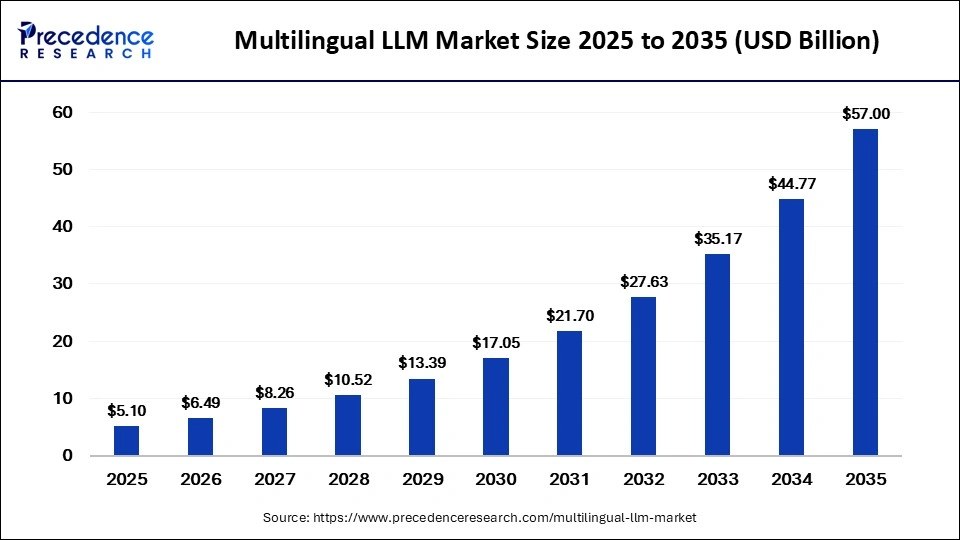
Multilingual large language models (LLMs) are transforming global communication by enabling AI-powered translation, multilingual customer support, enterprise knowledge management, content generation, and localization at scale. Businesses operating internationally increasingly require AI systems capable of supporting regional languages, dialects, and culturally nuanced interactions.
The rapid expansion of non-English digital economies across Asia-Pacific, Latin America, the Middle East, and Africa is significantly accelerating demand for multilingual AI infrastructure. Organizations are prioritizing AI systems capable of delivering localized experiences while maintaining contextual accuracy and brand consistency across markets.
Read Also: AI Explainability and Transparency Market
What Are Multilingual LLMs?
Multilingual LLMs are advanced artificial intelligence models trained to understand and generate text in multiple languages simultaneously. Unlike traditional translation systems, these models can understand context, sentiment, tone, idiomatic expressions, and cultural nuances.
These systems support a wide range of enterprise applications, including:
- AI-powered translation and localization
- Multilingual customer support
- Enterprise communication
- Voice assistants
- Intelligent chatbots
- Content generation
- Knowledge management
- Cross-border e-commerce
Modern multilingual AI models increasingly integrate multimodal capabilities, allowing them to process text, voice, images, and video simultaneously for more interactive user experiences.
Key Market Drivers
Rapid Growth of Non-English Digital Economies
One of the strongest growth drivers in the multilingual LLM market is the rapid expansion of non-English internet ecosystems.
Countries across Asia-Pacific, South America, and the Middle East are witnessing strong growth in internet penetration, digital commerce, and AI adoption. Businesses increasingly require localized AI systems capable of supporting users in their native languages to improve accessibility and engagement.
Governments are also investing heavily in sovereign AI ecosystems to reduce dependence on Western-centric AI models. India’s Bhashini initiative and China’s growing domestic LLM ecosystem are contributing significantly to multilingual AI innovation.
Enterprise Adoption of Generative AI
The rapid enterprise adoption of generative AI technologies is significantly fueling the multilingual LLM market.
Organizations increasingly deploy AI systems for:
- Automated customer support
- Global marketing campaigns
- Content localization
- Enterprise workflow automation
- Product documentation
- Internal knowledge management
Businesses now expect AI models to generate high-quality outputs across languages such as Hindi, Arabic, Mandarin, Spanish, Japanese, Korean, and Portuguese—not only English.
The content generation segment accounted for approximately 20% of the market share in 2025 and is projected to witness the fastest CAGR of 30.5% during the forecast period.
Rising Demand for Translation and Localization
Translation and localization remain the dominant application segment, accounting for around 28% of the market share in 2025.
Multilingual LLMs allow enterprises to create culturally relevant:
- Product descriptions
- Customer interactions
- Marketing campaigns
- Technical documentation
- Real-time communication systems
Industries increasingly leveraging multilingual localization include retail, media, travel, education, SaaS, and telecommunications.
Expansion of Retrieval-Augmented Generation (RAG)
Retrieval-Augmented Generation (RAG) is emerging as one of the fastest-growing technologies in the multilingual LLM ecosystem.
The RAG segment is expected to grow at a CAGR of 31.5% through 2035.
RAG systems improve multilingual AI accuracy by retrieving real-time information from enterprise databases and external knowledge repositories before generating responses. This reduces hallucinations while improving contextual reliability and traceability.
Industries such as finance, healthcare, legal services, and enterprise IT increasingly deploy multilingual RAG systems for secure and compliant knowledge retrieval.
Market Restraints
High Computational and Infrastructure Costs
Despite strong growth opportunities, multilingual LLM development requires substantial computational resources and large-scale multilingual datasets.
Training models across dozens of languages significantly increases GPU consumption, infrastructure costs, and optimization complexity. Smaller enterprises and startups often struggle to compete with hyperscalers and large AI providers due to these high barriers.
Complexity of Multilingual Content Generation
Generating high-quality multilingual output is far more complex than direct translation.
AI systems must account for:
- Regional dialects
- Cultural nuances
- Sentence structure variations
- Industry-specific terminology
- Local communication styles
Maintaining consistency and contextual accuracy across languages remains one of the biggest challenges in multilingual AI deployment.
A recent Reddit discussion from developers building multilingual AI systems highlighted that multilingual output “is not just translation,” emphasizing the importance of language-specific prompting and cultural adaptation for production-quality AI systems.
Reliability and Hallucination Risks
AI hallucinations and inconsistent multilingual responses continue to be major concerns for enterprises deploying multilingual AI systems at scale.
Organizations operating in regulated industries increasingly require:
- Human oversight mechanisms
- Output validation systems
- Governance frameworks
- Explainability layers
- Compliance monitoring
Ensuring reliability across multiple languages remains a significant technical challenge for vendors and enterprises alike.
Emerging Opportunities
Rise of Sovereign AI Ecosystems
Governments and enterprises worldwide increasingly seek sovereign AI systems capable of supporting local languages, regulations, and cultural requirements.
This trend is creating major opportunities for:
- Regional AI startups
- Open-source multilingual frameworks
- Localization-focused AI providers
- Language-specific infrastructure vendors
Countries across Asia-Pacific and Europe are accelerating investments in localized AI ecosystems to strengthen technological independence.
Growth of Domain-Specific Multilingual Models
Domain-specific multilingual LLMs are rapidly gaining traction across industries such as healthcare, finance, cybersecurity, and legal services.
These specialized models offer:
- Improved contextual understanding
- Lower hallucination rates
- Industry-specific terminology support
- Enhanced compliance management
Organizations increasingly fine-tune multilingual models using proprietary enterprise datasets to improve accuracy and operational efficiency.
Expansion of Multimodal AI Systems
The market is evolving toward multimodal AI systems capable of processing text, voice, images, and video simultaneously.
Multimodal multilingual assistants are expected to reshape:
- Customer support
- Healthcare communication
- Enterprise collaboration
- Educational platforms
- Media and entertainment services
The integration of voice and language intelligence technologies is expected to create substantial opportunities across global digital ecosystems.
Segment Analysis
Cloud-Based Deployment Dominates the Market
The cloud-based deployment segment dominated the market with an 85% share in 2025.
Cloud infrastructure enables organizations to access scalable AI computing resources and multilingual AI services without major upfront infrastructure investments.
Meanwhile, on-premise deployment continues witnessing steady growth among enterprises prioritizing stricter data governance and regulatory compliance.
Transformer Models Lead Technology Segment
Transformer-based architectures accounted for approximately 40% of the market share in 2025 due to their ability to efficiently process massive multilingual datasets.
Self-attention mechanisms within transformer models allow multilingual AI systems to better understand contextual relationships across languages, improving reasoning and content generation quality.
Translation & Localization Hold Largest Application Share
Translation and localization remained the largest application segment with a 28% market share in 2025.
Customer support and chatbot applications accounted for approximately 22% of the market, while content generation is expected to witness the fastest growth throughout the forecast period.
IT & Telecom Sector Dominates End-Use Segment
The IT and telecom sector accounted for approximately 30% of the market share in 2025 due to strong AI adoption, rising R&D investments, and increasing demand for multilingual digital services.
Retail and e-commerce are projected to witness the fastest CAGR of 31.5% through 2035 as retailers increasingly prioritize multilingual customer engagement systems.
Regional Analysis
North America Leads the Global Market
North America held the largest market share of 42% in 2025 due to advanced AI infrastructure, strong enterprise adoption, and the presence of major hyperscalers and foundational AI model providers.
The United States remains the dominant regional market and is projected to reach approximately USD 18.29 billion by 2035.
Asia-Pacific Emerges as Fastest-Growing Region
Asia-Pacific is projected to grow at the fastest CAGR of 32.5% during the forecast period.
The region benefits from:
- Massive language diversity
- Expanding internet penetration
- Government AI initiatives
- Rapid digital transformation
- Strong sovereign AI investments
India and China are becoming major hubs for multilingual AI innovation and deployment.
Europe Maintains Strong Market Position
Europe accounted for approximately 22% of the market share in 2025 due to increasing enterprise demand for multilingual communication and strict AI governance regulations.
European enterprises increasingly prioritize AI systems capable of supporting cross-border communication while maintaining GDPR compliance.
Competitive Landscape
The multilingual LLM market is highly competitive, with hyperscalers, AI startups, open-source communities, and enterprise software providers investing heavily in multilingual capabilities.
Key Companies Operating in the Market
Major companies operating in the market include:
- OpenAI
- Microsoft
- Meta
- Anthropic
- Alibaba Cloud
- Tencent
- Cohere
- IBM
- Amazon Web Services
Get a Sample Copy: https://www.precedenceresearch.com/sample/8407
For inquiries regarding discounts, bulk purchases, or customization requests, please contact us at sales@precedenceresearch.com
