
 by
by The global injection molding market is projected to reach USD 468.92 billion by 2035, driven by increasing demand for lightweight plastic components, rapid industrialization, automotive production growth, and advancements in smart manufacturing technologies.
Introduction
The global injection molding market is witnessing remarkable growth as industries increasingly rely on high-volume, cost-efficient manufacturing processes for producing complex plastic and metal components. Injection molding has become one of the most widely used manufacturing technologies across automotive, packaging, consumer goods, electronics, healthcare, and construction industries due to its ability to deliver precision, scalability, and operational efficiency.
The rising demand for lightweight materials, customized product designs, sustainable packaging solutions, and advanced medical devices is significantly accelerating the adoption of injection molding technologies worldwide. In addition, the rapid integration of automation, robotics, and artificial intelligence into manufacturing operations is transforming traditional injection molding facilities into smart production environments.
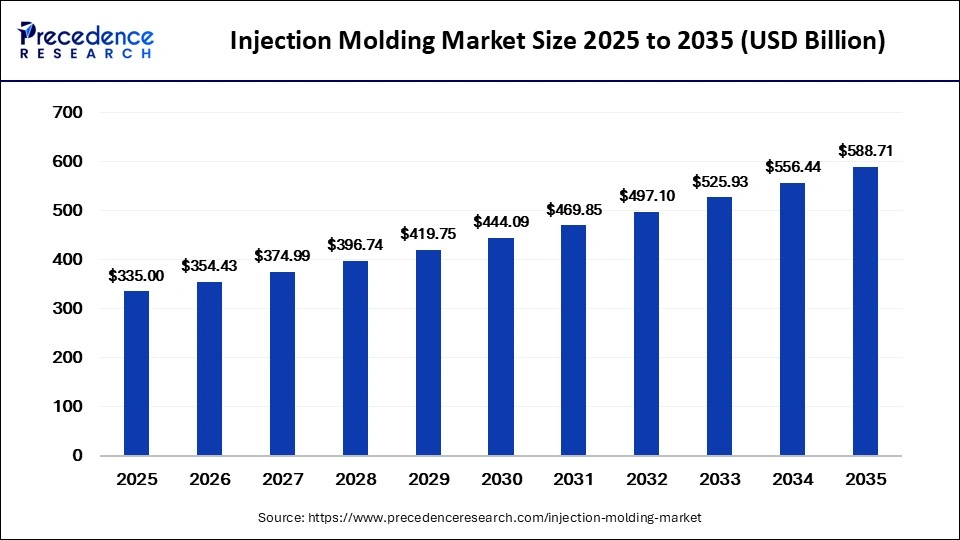
According to Precedence Research, the global injection molding market size was valued at USD 329.41 billion in 2025 and is projected to increase from USD 342.83 billion in 2026 to approximately USD 468.92 billion by 2035, expanding at a CAGR of 3.55% during the forecast period.
Read Also: Metal Coil Lamination Market
Injection Molding Market Overview
Injection molding is a manufacturing process used to produce parts by injecting molten material into molds under high pressure. The process is extensively used for manufacturing plastic components, metal parts, elastomers, and composite products across multiple industrial applications.
Injection molding offers several advantages, including:
- High production efficiency
- Excellent dimensional accuracy
- Reduced material waste
- Cost-effective mass production
- Complex shape manufacturing capability
- Consistent product quality
The growing shift toward lightweight materials and sustainable manufacturing practices continues to strengthen market demand globally. Advanced injection molding technologies now support the production of highly customized, durable, and precision-engineered components required in modern industrial applications.
Key Market Drivers
Rising Demand for Lightweight Automotive Components
The automotive industry remains one of the most significant drivers of injection molding market growth.
Automotive manufacturers increasingly use injection-molded plastic components to reduce vehicle weight, improve fuel efficiency, and support electric vehicle (EV) production. Injection molding technologies allow automakers to manufacture complex interior and exterior parts with improved precision and durability.
The automotive segment is expected to expand at a CAGR of 5.2% during the forecast period due to increasing EV adoption and lightweight material demand.
Growth of Packaging Industry
Packaging represented 32% of global market share in 2025 because of increasing demand for plastic packaging solutions across food & beverages, pharmaceuticals, personal care, and e-commerce industries.
Injection molding technologies enable manufacturers to produce lightweight, durable, and cost-effective packaging products at large scale while supporting customized designs and sustainable packaging initiatives.
The rapid growth of online retail and consumer packaged goods continues accelerating packaging demand globally.
Increasing Adoption of Medical Devices
Healthcare applications are emerging as a major growth area for injection molding technologies.
Medical device manufacturers increasingly require precision-engineered components for syringes, diagnostic equipment, surgical instruments, drug delivery systems, and implantable devices. Injection molding supports sterile manufacturing environments and high-volume production efficiency required by the healthcare sector.
The growing aging population and rising healthcare expenditures are expected to create substantial long-term opportunities.
Advancements in Smart Manufacturing and Automation
The integration of Industry 4.0 technologies is significantly transforming injection molding operations worldwide.
Manufacturers increasingly deploy robotics, artificial intelligence, IoT-enabled sensors, predictive maintenance systems, and automated quality inspection technologies to improve production efficiency and reduce operational costs.
Smart injection molding systems enable real-time process monitoring, defect reduction, and optimized energy consumption.
Impact of Artificial Intelligence on Injection Molding Industry
Artificial intelligence is playing an increasingly important role in improving injection molding manufacturing efficiency, quality control, and predictive maintenance capabilities.
AI-powered systems analyze machine performance, mold conditions, temperature variations, and production parameters in real time to optimize operational performance and minimize defects. Machine learning algorithms help manufacturers improve cycle times, reduce waste, and enhance product consistency.
AI technologies are also enabling:
- Automated defect detection
- Predictive maintenance
- Smart process optimization
- Energy efficiency improvement
- Supply chain optimization
- Real-time production analytics
The increasing adoption of AI-enabled manufacturing systems is expected to reshape the future of the injection molding industry.
Market Trends
Rising Demand for Sustainable and Recyclable Materials
Sustainability has become a major trend across the injection molding industry.
Manufacturers increasingly adopt biodegradable plastics, recycled polymers, and bio-based materials to comply with environmental regulations and growing consumer demand for sustainable products.
The growing emphasis on circular economy initiatives is accelerating investments in eco-friendly injection molding technologies.
Growth of Electric Injection Molding Machines
Electric injection molding machines accounted for 36% market share in 2025 due to their superior energy efficiency, precision control, and lower operational noise levels.
Manufacturers increasingly prefer electric machines because they reduce energy consumption and improve production consistency compared to hydraulic systems.
Expansion of Multi-Material and Micro Injection Molding
Advanced multi-material injection molding technologies are gaining strong adoption across automotive, electronics, and healthcare industries.
Micro injection molding is also witnessing significant growth because of increasing demand for miniature medical devices, wearable electronics, and micro-components.
Increasing Use of Robotics and Automation
Robotic automation systems are becoming increasingly common within injection molding facilities.
Automation technologies improve operational speed, reduce labor dependency, and enhance manufacturing accuracy while supporting continuous production operations.
Market Restraints
Fluctuating Raw Material Prices
The injection molding industry remains highly dependent on petrochemical-based raw materials such as polypropylene, polyethylene, ABS, and polystyrene.
Volatility in crude oil prices and supply chain disruptions continue affecting production costs and profitability.
Environmental Concerns Related to Plastic Waste
Growing environmental concerns regarding plastic waste and pollution continue creating regulatory challenges for manufacturers.
Governments worldwide increasingly implement stricter regulations on single-use plastics and non-recyclable materials, which may affect market growth.
High Initial Equipment Investment
Advanced injection molding machines, robotic systems, and automation infrastructure require substantial capital investment.
Small and medium-sized manufacturers may face financial limitations when upgrading production capabilities.
Complex Mold Design and Maintenance
Injection molding requires highly precise mold design and regular maintenance to ensure product quality and operational efficiency.
Mold manufacturing and repair costs may increase overall production expenses, particularly for highly customized applications.
Emerging Opportunities
Expansion of Electric Vehicle Manufacturing
The rapid growth of electric vehicles is creating substantial opportunities for lightweight injection-molded components.
EV manufacturers increasingly rely on plastic and composite materials to improve energy efficiency and reduce vehicle weight.
Growth in Medical and Healthcare Applications
The healthcare sector continues creating strong demand for precision injection molding solutions.
Increasing production of diagnostic devices, wearable healthcare technologies, and minimally invasive surgical equipment is expected to support market expansion.
Development of Bio-Based Polymers
The growing shift toward sustainable manufacturing is accelerating research and development activities focused on biodegradable and bio-based polymers.
Manufacturers investing in eco-friendly materials are expected to gain competitive advantages in the coming years.
Industrialization Across Emerging Economies
Rapid industrialization across Asia-Pacific, Latin America, and the Middle East continues generating strong demand for injection-molded products across packaging, automotive, construction, and consumer goods industries.
Segmental Analysis
By Material
Plastics Segment Dominance
Plastics dominated the market with 87% share in 2025 because of their versatility, affordability, lightweight properties, and large-scale industrial applications.
Thermoplastics Leadership
Thermoplastics accounted for 72% share within the plastic segment due to their recyclability, durability, and ease of processing.
Metal Injection Molding Growth
Metal injection molding continues gaining traction across aerospace, medical, and automotive industries because of increasing demand for precision-engineered metal components.
By Machine Type
Electric Machine Growth
Electric injection molding machines held 36% market share in 2025 due to energy efficiency and operational precision advantages.
Hydraulic Machines Demand
Hydraulic machines continue witnessing stable demand for heavy-duty industrial applications requiring high clamping force.
By End Use
Packaging Segment Dominance
Packaging dominated the market with 32% share in 2025 because of increasing demand for food packaging, beverage containers, and pharmaceutical packaging products.
Automotive Segment Growth
Automotive applications are expected to grow rapidly due to increasing EV production and lightweight component demand.
Healthcare Applications Expansion
Healthcare continues witnessing substantial growth because of increasing medical device manufacturing activities.
Regional Analysis
Asia-Pacific
Asia-Pacific dominated the injection molding market with 44% share in 2025 due to strong manufacturing infrastructure, rapid industrialization, and growing automotive and packaging industries.
China, India, Japan, and South Korea remain major manufacturing hubs because of large-scale industrial production and rising demand for consumer goods and automotive components.
China continues leading global injection molding production because of its extensive plastics manufacturing ecosystem and export-oriented industrial infrastructure.
North America
North America continues witnessing strong demand driven by advanced manufacturing technologies, medical device production, and increasing automation adoption.
The United States remains a major market because of strong automotive and healthcare manufacturing industries.
Europe
Europe increasingly focuses on sustainable manufacturing, electric vehicle production, and recyclable material innovation.
Germany, France, and Italy remain key regional markets because of strong industrial manufacturing capabilities.
Latin America and Middle East & Africa
These regions are gradually expanding their industrial production capacities and packaging industries, creating long-term market opportunities.
Key Companies in the Injection Molding Market
Major companies operating in the market include:
- Husky Technologies
- Engel Austria GmbH
- Arburg GmbH
- Sumitomo Heavy Industries
- Milacron
- Nissei Plastic Industrial
- Haitian International
- KraussMaffei
- Toshiba Machine
- JSW Plastics Machinery
These companies are focusing on AI-enabled manufacturing systems, electric injection molding technologies, sustainable material innovation, and advanced automation solutions to strengthen their competitive positions.
Get a Sample Copy: https://www.precedenceresearch.com/sample/8410
For inquiries regarding discounts, bulk purchases, or customization requests, please contact us at sales@precedenceresearch.com
