
 by
by The global AI in pharma supply chain market is projected to reach USD 24.69 billion by 2035, driven by rising adoption of machine learning, predictive analytics, warehouse automation, and demand forecasting technologies across pharmaceutical supply chains.
Introduction
The pharmaceutical industry is rapidly transforming its supply chain operations through the integration of artificial intelligence (AI), machine learning, predictive analytics, and automation technologies. As pharmaceutical companies face growing challenges related to inventory management, drug shortages, regulatory compliance, cold chain logistics, and global distribution complexity, AI-powered supply chain solutions are becoming essential for operational resilience and efficiency.
AI technologies are enabling pharmaceutical companies to improve demand forecasting, optimize inventory management, automate warehouses, monitor cold chain transportation, reduce operational costs, and enhance supply chain visibility in real time. The increasing complexity of biologics, personalized medicine, and temperature-sensitive pharmaceutical products is further accelerating demand for intelligent supply chain systems worldwide.
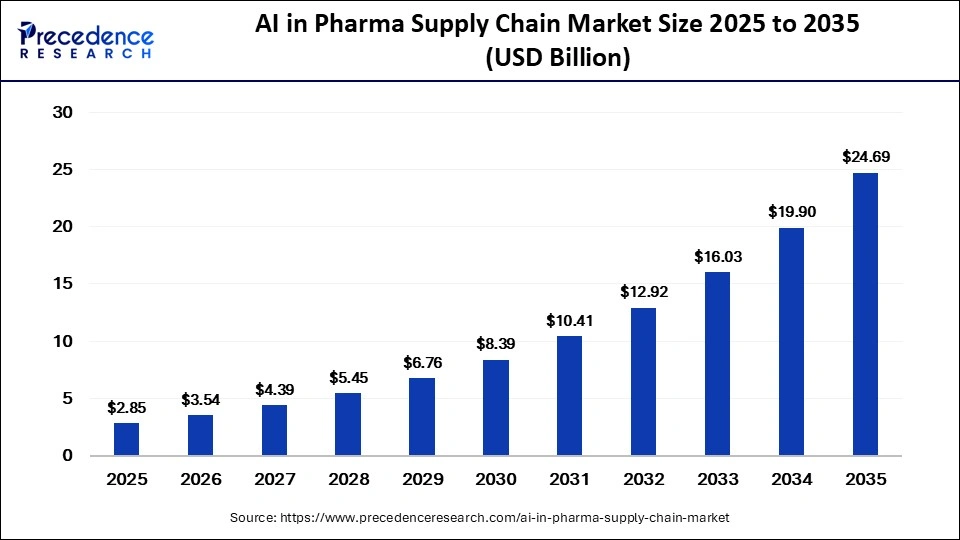
According to Precedence Research, the global AI in pharma supply chain market size was valued at USD 2.85 billion in 2025 and is projected to increase from USD 3.54 billion in 2026 to approximately USD 24.69 billion by 2035, expanding at a CAGR of 24.10% during the forecast period.
Read Also: Multilingual LLM Market
AI in Pharma Supply Chain Market Overview
AI in pharmaceutical supply chain refers to the use of advanced technologies such as machine learning, predictive analytics, natural language processing (NLP), computer vision, robotic process automation (RPA), and intelligent automation to optimize pharmaceutical manufacturing, logistics, inventory management, and distribution processes.
Traditional pharmaceutical supply chains often struggle with operational inefficiencies, fragmented data systems, unpredictable demand fluctuations, cold chain monitoring challenges, and compliance complexities. AI-powered supply chain systems help organizations transition from reactive operations to intelligent, proactive, and self-healing supply chains.
Leading pharmaceutical companies are increasingly deploying AI-driven technologies for:
- Real-time inventory optimization
- Predictive demand forecasting
- Route and logistics optimization
- Automated warehouse management
- Risk and compliance monitoring
- Counterfeit drug prevention
- Cold chain integrity management
The market is rapidly shifting from pilot AI initiatives to enterprise-wide implementation across pharmaceutical ecosystems.
Key Market Statistics
Major Market Highlights
- The AI in pharma supply chain market is expected to grow at a CAGR of 24.10% from 2026 to 2035.
- North America accounted for 41% of global market share in 2025.
- Asia-Pacific is projected to witness the fastest CAGR of 29.5% during the forecast period.
- Cloud-based deployment dominated the market with 72% share in 2025.
- Machine learning accounted for 30% of technology segment share in 2025.
- Demand forecasting represented 24% of application market share in 2025.
- Pharmaceutical manufacturers held 42% of end-use market share in 2025.
- Cold chain monitoring is expected to witness a CAGR of 27.5% through 2035.
- AI adoption in pharmaceutical R&D and supply chain operations continues accelerating globally.
Key Market Drivers
Rising Need for Demand Forecasting and Inventory Optimization
Demand forecasting remains one of the most critical applications of AI within pharmaceutical supply chains.
The pharmaceutical industry often faces unpredictable fluctuations in medication demand caused by pandemics, disease outbreaks, seasonal variations, and changing healthcare requirements. AI-powered forecasting systems analyze real-time data, historical sales patterns, healthcare trends, and external market factors to improve forecasting accuracy and minimize stockouts.
The demand forecasting segment accounted for 24% market share in 2025 due to its ability to improve supply chain efficiency and reduce overstocking costs. AI-enabled forecasting systems can improve prediction accuracy by up to 50%, significantly enhancing profitability and operational planning.
Expansion of Cold Chain Logistics and Biologics Manufacturing
The rapid growth of biologics, vaccines, gene therapies, and temperature-sensitive pharmaceutical products is increasing demand for advanced cold chain management systems.
AI-powered cold chain monitoring solutions help pharmaceutical companies track temperature conditions, identify disruptions, predict failures, and maintain product integrity throughout transportation and storage processes. The cold chain monitoring segment is projected to grow at a CAGR of 27.5% through 2035.
Real-time monitoring systems are becoming increasingly important as pharmaceutical companies distribute high-value biologics across complex global supply chains.
Increasing Adoption of Cloud-Based Supply Chain Platforms
Cloud-based deployment dominated the market with 72% share in 2025 because of its scalability, cost efficiency, and real-time data integration capabilities.
Cloud-based AI systems allow pharmaceutical manufacturers, distributors, regulators, and logistics providers to securely share complex operational datasets while improving collaboration and visibility across supply chain networks.
The increasing adoption of Software-as-a-Service (SaaS) platforms and digital supply chain ecosystems continues to accelerate market growth.
Rising Focus on Supply Chain Resilience and Risk Management
Global disruptions caused by pandemics, geopolitical instability, transportation bottlenecks, and raw material shortages have highlighted vulnerabilities within pharmaceutical supply chains.
AI-powered supply chain risk assessment systems can identify potential disruptions, simulate risk scenarios, and recommend mitigation strategies before operational failures occur. Research on AI-driven supply chain risk assessment highlights significant improvements in predictive capabilities and resilience management using machine learning models such as XGBoost and Random Forest.
The growing need for resilient and adaptive supply chains continues to accelerate AI adoption worldwide.
Impact of Artificial Intelligence on Pharma Supply Chains
Artificial intelligence is fundamentally reshaping pharmaceutical supply chain operations through automation, predictive analytics, and intelligent decision-making systems.
AI technologies enable pharmaceutical organizations to:
- Automate warehouse operations
- Predict supply disruptions
- Optimize transportation routes
- Reduce inventory holding costs
- Detect counterfeit medications
- Improve compliance monitoring
- Enhance manufacturing efficiency
Many pharmaceutical organizations are now leveraging digital twins to create virtual supply chain replicas capable of simulating disruptions and testing operational strategies in risk-free environments.
AI integration with blockchain technology is also improving transparency, product traceability, and counterfeit drug prevention across pharmaceutical distribution networks.
Leading pharmaceutical companies including AstraZeneca and Novartis are increasingly using AI-powered supply chain systems for predictive inventory management and operational optimization.
Market Trends
Growth of Warehouse Automation
Warehouse automation is becoming one of the fastest-growing segments within the market.
The warehouse automation segment is projected to expand at a CAGR of 26.5% through 2035 as pharmaceutical companies increasingly deploy robotics, AI-driven sorting systems, autonomous mobile robots, and automated picking technologies.
Automation technologies improve operational efficiency while reducing manual handling errors and labor dependency.
Integration of AI with Blockchain Technology
Pharmaceutical companies are increasingly integrating AI with blockchain systems to improve end-to-end product traceability, compliance, and anti-counterfeiting capabilities.
Blockchain-enabled AI platforms help ensure transaction transparency while reducing risks associated with counterfeit drugs and unauthorized distribution channels.
This trend is expected to gain substantial momentum as regulatory oversight increases globally.
Expansion of Predictive Analytics Applications
Predictive analytics accounted for 25% market share in 2025 and continues to witness strong growth across pharmaceutical supply chains.
Predictive analytics systems help organizations forecast disruptions, optimize inventory levels, improve transportation efficiency, and reduce operational costs using real-time operational intelligence.
Increasing Investment in AI-Powered Pharmaceutical Operations
Pharmaceutical companies are aggressively increasing investments in AI technologies across manufacturing, R&D, logistics, and clinical operations.
Reuters reported that pharmaceutical companies are increasingly leveraging AI to reduce development costs, accelerate operations, and improve overall efficiency across drug development and supply chain ecosystems.
Industry experts believe AI could potentially reduce early-stage development timelines and operational costs by nearly half over the next several years.
Market Restraints
Data Security and Privacy Concerns
Pharmaceutical supply chains handle highly sensitive clinical, manufacturing, and patient-related data.
Organizations often face challenges related to cybersecurity, data privacy compliance, and intellectual property protection when implementing cloud-based AI platforms. These concerns may limit adoption among highly regulated pharmaceutical environments.
High Initial Implementation Costs
Deploying AI-powered pharmaceutical supply chain infrastructure requires substantial investments in software platforms, cloud infrastructure, robotics, sensors, analytics systems, and employee training.
Small and mid-sized pharmaceutical organizations may face financial barriers when adopting advanced AI technologies.
Complexity of Integration with Legacy Systems
Many pharmaceutical companies continue operating with fragmented legacy systems and outdated operational infrastructure.
Integrating modern AI technologies with existing enterprise resource planning (ERP), manufacturing execution systems (MES), and logistics infrastructure can be technically complex and resource intensive.
Regulatory and Compliance Challenges
Pharmaceutical supply chains operate under strict regulatory requirements related to product safety, quality control, serialization, and data management.
AI-powered operational systems must comply with evolving global regulations, including FDA guidelines and Good Manufacturing Practice (GMP) standards.
Emerging Opportunities
Expansion of Biopharmaceutical Manufacturing
Biotechnology companies are projected to witness the fastest CAGR of 28.5% through 2035 due to increasing AI adoption across complex biologics manufacturing and supply chain operations.
Biotech firms manage large datasets and highly sensitive products that benefit significantly from predictive analytics and AI-driven logistics optimization.
Growth in Personalized Medicine
The increasing shift toward personalized medicine and precision therapeutics is creating substantial opportunities for intelligent pharmaceutical logistics systems.
AI technologies help pharmaceutical companies manage highly customized supply chains capable of supporting patient-specific treatment distribution.
Research highlights how AI-driven personalized medicine is reshaping pharmaceutical operations and healthcare delivery globally.
Expansion of AI-Driven Compliance Management
Risk and compliance management solutions are increasingly important within pharmaceutical operations.
AI systems can automatically monitor compliance requirements, identify anomalies, and generate audit-ready documentation to support regulatory reporting and operational transparency.
Increasing Adoption in Emerging Markets
Rapid pharmaceutical manufacturing expansion across Asia-Pacific, Latin America, and the Middle East is creating significant opportunities for AI-powered supply chain technologies.
Emerging economies increasingly seek intelligent logistics systems capable of supporting large-scale pharmaceutical production and distribution operations.
Segmental Analysis
By Deployment Mode
Cloud-Based Segment Dominance
Cloud-based deployment dominated the market with 72% share in 2025 because of its scalability, cost efficiency, and real-time collaboration capabilities.
On-Premise Systems Growth
On-premise deployment continues to witness stable growth due to increasing demand for enhanced data security and regulatory compliance.
Organizations handling sensitive intellectual property often prefer on-premise deployment models.
By Technology
Machine Learning Leadership
Machine learning accounted for 30% market share in 2025 due to its ability to analyze complex operational datasets and support predictive decision-making.
Predictive Analytics Expansion
Predictive analytics represented 25% market share and continues to gain traction for inventory optimization and supply chain forecasting applications.
Computer Vision Growth
Computer vision systems are increasingly used for automated quality inspection, packaging verification, and warehouse monitoring.
By Application
Demand Forecasting Dominance
Demand forecasting held the largest market share of 24% in 2025 because of its direct impact on reducing stockouts and operational inefficiencies.
Inventory Management Growth
Inventory management accounted for 22% market share due to rising demand for real-time inventory optimization systems.
Warehouse Automation Expansion
Warehouse automation is projected to witness one of the fastest growth rates during the forecast period.
By End Use
Pharmaceutical Manufacturers Leadership
Pharmaceutical manufacturers dominated the market with 42% share in 2025 because of rising investments in AI-powered manufacturing and logistics optimization systems.
Biotechnology Companies Growth
Biotechnology companies are projected to witness the fastest CAGR of 28.5% through 2035 due to increasing AI integration within biologics manufacturing ecosystems.
Regional Analysis
North America
North America dominated the AI in pharma supply chain market with 41% share in 2025 due to strong pharmaceutical R&D infrastructure, advanced healthcare technologies, and high AI adoption rates.
The United States remains the leading regional market because of proactive FDA initiatives supporting AI integration and digital supply chain innovation.
Major pharmaceutical companies across the region are increasingly collaborating with AI technology firms to improve operational efficiency and supply chain resilience.
Asia-Pacific
Asia-Pacific is expected to witness the fastest CAGR of 29.5% during the forecast period.
The region is emerging as a major hub for pharmaceutical manufacturing, AI-driven logistics systems, and clinical research operations.
China, India, Japan, and South Korea are investing heavily in intelligent manufacturing and pharmaceutical digitalization initiatives.
Europe
Europe continues to witness strong growth due to increasing regulatory focus on supply chain transparency, sustainability, and pharmaceutical traceability.
Countries such as Germany, Switzerland, and the United Kingdom are rapidly adopting AI-powered pharmaceutical logistics systems.
Latin America and Middle East & Africa
These regions are gradually increasing investments in healthcare infrastructure modernization and pharmaceutical distribution systems, creating long-term growth opportunities for AI-enabled supply chain technologies.
Key Companies in the AI in Pharma Supply Chain Market
Major companies operating in the market include:
- IBM
- Microsoft
- SAP
- Oracle
- Amazon Web Services
- Blue Yonder
- Kinaxis
- Siemens
- Accenture
- NVIDIA
These companies are focusing on predictive analytics, cloud-based supply chain management, AI-powered automation, blockchain integration, and pharmaceutical logistics optimization technologies.
Get a Sample Copy: https://www.precedenceresearch.com/sample/8408
For inquiries regarding discounts, bulk purchases, or customization requests, please contact us at sales@precedenceresearch.com
