
 by
by The CAD mammography market is rapidly evolving as healthcare systems prioritize early detection and precision diagnostics for breast cancer. CAD systems enhance traditional mammography by using intelligent algorithms to detect abnormalities, supporting radiologists in improving diagnostic accuracy. The market was valued at USD 1.10 billion in 2025 and is expected to reach USD 2.70 billion by 2035, growing at a CAGR of 9.40% from 2026 to 2035.
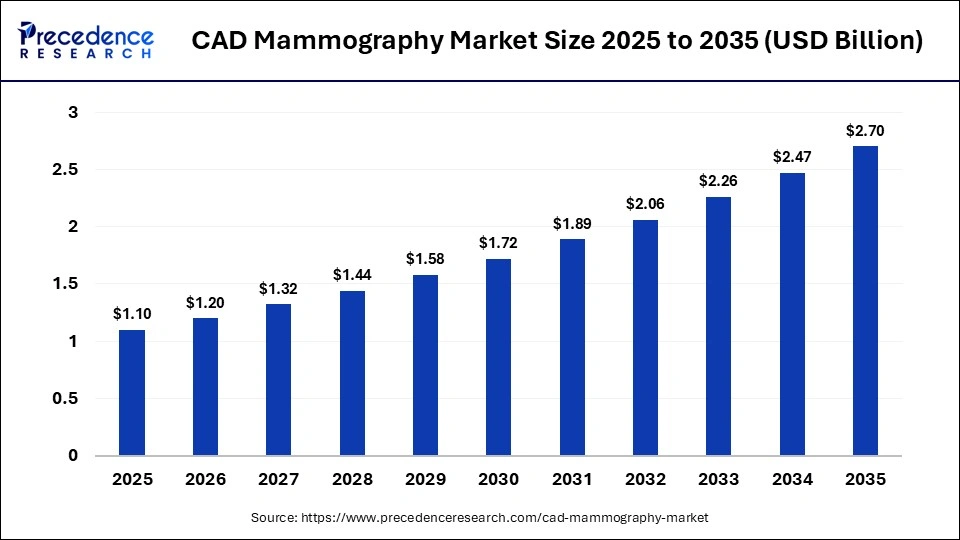
This growth is strongly influenced by the rising global burden of breast cancer and increasing adoption of AI-powered imaging technologies in healthcare systems worldwide.
Read Also: Data Labeling and Annotation Tools Market
Quick Insights (Market Snapshot)
- North America led with ~40% share in 2025
- Asia Pacific is the fastest-growing region (~10.5% CAGR)
- 3D mammography dominated with ~55% share
- Full-field digital mammography (FFDM) held ~60% share
- Hospitals accounted for ~55% share
- Diagnostic imaging centers are expanding rapidly
- Contrast-enhanced mammography is the fastest-growing technology
How is AI Transforming CAD Mammography?
Artificial intelligence is redefining CAD mammography by enabling faster, more accurate, and more consistent interpretation of breast imaging data. AI-powered CAD systems analyze mammograms in real time to highlight suspicious regions, helping radiologists detect early-stage cancers that might otherwise be missed.
Deep learning algorithms are significantly improving image recognition accuracy, while AI also supports breast density analysis, lesion classification, and risk-based screening models. These innovations are reducing false positives and improving diagnostic confidence across clinical settings.
Market Growth Drivers
Why is Breast Cancer Prevalence Driving Demand?
Breast cancer remains one of the most common cancers globally, with millions of new cases annually, driving strong demand for early diagnostic solutions like CAD mammography.
How Are Screening Programs Supporting Growth?
Government-backed screening programs are expanding globally, increasing the number of mammography procedures and boosting adoption of CAD-assisted imaging systems.
Why is Radiologist Workload a Key Factor?
Growing imaging volumes and a shortage of radiologists are pushing healthcare providers to adopt AI-assisted diagnostic tools to improve efficiency and reduce workload pressure.
Segment Analysis
By Type: Why Does 3D Mammography Dominate?
- 3D Mammography (Tomosynthesis) leads with ~55% share due to superior imaging depth
- 2D Mammography remains widely used due to affordability and accessibility
3D imaging provides better lesion visibility and reduces false positives, making it a preferred diagnostic tool.
By Technology: What Drives Market Leadership?
- Full-Field Digital Mammography (FFDM) dominates with ~60% share due to AI compatibility
- Digital Breast Tomosynthesis (DBT) is growing rapidly (~13% CAGR)
- Contrast-Enhanced Mammography (CEM) is the fastest-growing (~16% CAGR)
- Analog systems are gradually declining but still used in low-resource regions
By End-Use: Who Uses CAD Mammography Most?
- Hospitals (~55%) dominate due to advanced imaging infrastructure
- Diagnostic imaging centers (~25%) are expanding quickly
- Screening clinics (~10%) are growing with preventive healthcare programs
- Others (~10%) include research and specialty centers
Regional Analysis
Why Does North America Lead the Market?
North America dominates due to advanced healthcare infrastructure, strong AI adoption, and high breast cancer awareness programs.
Why is Asia Pacific the Fastest Growing?
Asia Pacific is witnessing rapid growth due to rising cancer incidence, expanding healthcare access, and digital transformation in medical imaging systems.
What is Europe’s Role?
Europe benefits from government-supported screening programs and strong regulatory frameworks for early cancer detection technologies.
Competitive Landscape
Key companies operating in the CAD mammography market include:
- GE HealthCare
- Siemens Healthineers
- Hologic Inc.
- Philips Healthcare
- Fujifilm Holdings Corporation
- Canon Medical Systems Corporation
- Carestream Health
- Agfa-Gevaert Group
- Konica Minolta
- Medtronic PLC
These companies are focusing on AI integration, high-resolution imaging, and workflow automation in radiology systems.
Challenges and Market Barriers
- High cost of advanced CAD-enabled mammography systems
- Limited adoption in low-income healthcare regions
- Integration challenges with legacy imaging infrastructure
- Shortage of trained radiology professionals
Opportunities & Emerging Trends
How is Personalized Screening Changing the Market?
Risk-based and patient-specific screening models are improving early detection and reducing unnecessary procedures.
What Role Does AI Play in Future Growth?
AI is expected to become central in CAD systems, enabling fully automated detection and decision-support workflows.
Why is Preventive Healthcare Driving Adoption?
Growing emphasis on early diagnosis and preventive healthcare programs is increasing demand for advanced imaging technologies.
Case Insight: AI Enhancing Cancer Detection Accuracy
AI-integrated CAD systems are significantly improving early detection rates by identifying subtle abnormalities in breast tissue, leading to better treatment outcomes and reduced diagnostic delays in large-scale screening programs.
Conclusion
The CAD mammography market is entering a strong growth phase driven by AI innovation, rising cancer incidence, and expanding global screening initiatives. As healthcare systems shift toward precision diagnostics and early intervention, CAD technologies are becoming an essential component of modern radiology.
With steady expansion projected through 2035, the market will continue to play a vital role in advancing breast cancer detection and improving global patient outcomes.
For inquiries regarding discounts, bulk purchases, or customization requests, please contact us at [email protected]
