
 by
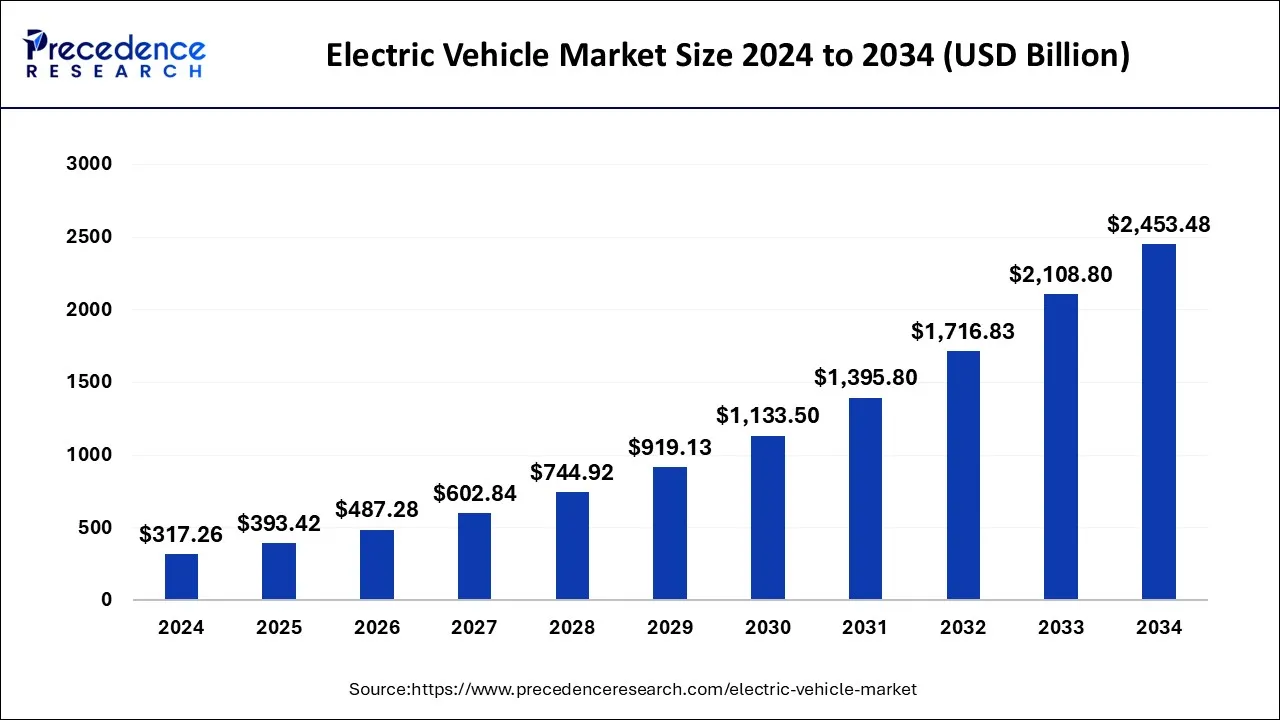
by The global electric vehicle market size was estimated at USD 988.70 billion in 2025 and is predicted to increase from USD 1,097.46 billion in 2026 to approximately USD 2,763.17 billion by 2035, expanding at a CAGR of 10.82% from 2026 to 2035. The market is driven by ongoing advances in battery technology and government initiatives to promote EVs.
Key Takeaway
- By region, Asia Pacific led the electric vehicle market in 2025.
- By region, North America is expected to grow at the fastest rate between 2026 and 2035.
- By propulsion type, the battery electric vehicles segment held a 67.7% share of the market in 2025.
- By propulsion type, the PHEV segment is expected to grow at the fastest rate between 2026 and 2035.
- By vehicle type, the passenger car segment held the highest share of the market in 2025.
- By vehicle type, the trucks segment is predicted to grow at the fastest CAGR in the market between 2026 and 2035.
- By vehicle class, the low-price electric vehicle segment held the highest market share in 2025.
- By vehicle class, the mid-price electric vehicle segment is predicted to grow at a significant rate from 2026 to 2035.
- By vehicle speed, the 100MPH-125MPH segment dominated the market in 2025.
- By vehicle speed, the less than 100MPH segment is expected to grow at a rapid pace between 2026 and 2035.
- By drive type, the front wheel drive segment acquired the largest share in 2025.
- By drive type, the all-wheel drive segment is expected to grow at a significant CAGR from 2026 to 2035.
- By end-use, the personal segment dominated the market in 2025.
- By end-use insights, the commercial use segment is expected to expand rapidly from 2026 to 2035.
Market Overview
The global electric vehicle (EV) industry is rapidly reshaping the transportation sector, fueled by increasing demand for sustainable mobility, strict emission regulations, and continuous technological advancements. Growing environmental awareness and fluctuating fuel prices are encouraging consumers and businesses to shift toward electric vehicles as a cleaner and more cost-effective alternative.
Market growth is further supported by the expansion of charging infrastructure, including investments in ultra-fast charging stations across highways, commercial hubs, and urban centers. These developments are enhancing charging convenience and reducing range anxiety, making EV ownership more practical for a wider audience.
In addition, strategic collaborations between automakers, technology companies, and charging network providers are driving innovation throughout the EV ecosystem. Manufacturers are launching a broader range of affordable, high-performance, and smart electric vehicles equipped with advanced connectivity and battery technologies, catering to evolving consumer expectations and accelerating global EV adoption.
Impact of AI on the Electric Vehicle Market
Artificial intelligence (AI) is becoming a key driver of innovation in the electric vehicle (EV) market, significantly improving vehicle efficiency, performance, and the overall driving experience. Advanced AI and machine learning algorithms enable intelligent battery management systems that optimize charging and discharging cycles, helping extend battery lifespan, enhance energy efficiency, and maximize driving range.
AI also improves the effectiveness of regenerative braking systems by analyzing driving patterns and road conditions to recover and utilize energy more efficiently. These capabilities contribute to better vehicle performance and reduced energy consumption.
Furthermore, AI-powered navigation and route-planning solutions help drivers identify nearby charging stations, estimate battery usage, and determine the most efficient routes based on traffic and charging availability. Beyond the vehicle itself, AI plays a vital role in smart energy management by supporting grid optimization, balancing electricity demand, and facilitating the integration of renewable energy sources. This enables EV charging to occur during the most efficient and cost-effective periods, enhancing both sustainability and energy reliability.
Market Report Coverage and Key Metrics
| Report Highlights | Details |
| Market Size in 2025 | USD 988.70 Billion |
| Market Size in 2026 | USD 1,097.46 Billion |
| Market Size by 2035 | USD 2,763.17 Billion |
| Growth Rate from 2026 to 2035 | CAGR of 10.82% |
| Largest Market | Asia Pacific |
| Base Year | 2025 |
| Forecast Period | 2026 to 2035 |
Market Regional Analysis: North America, Europe, Asia-Pacific
How Big is the Asia Pacific Electric Vehicle Market Size?
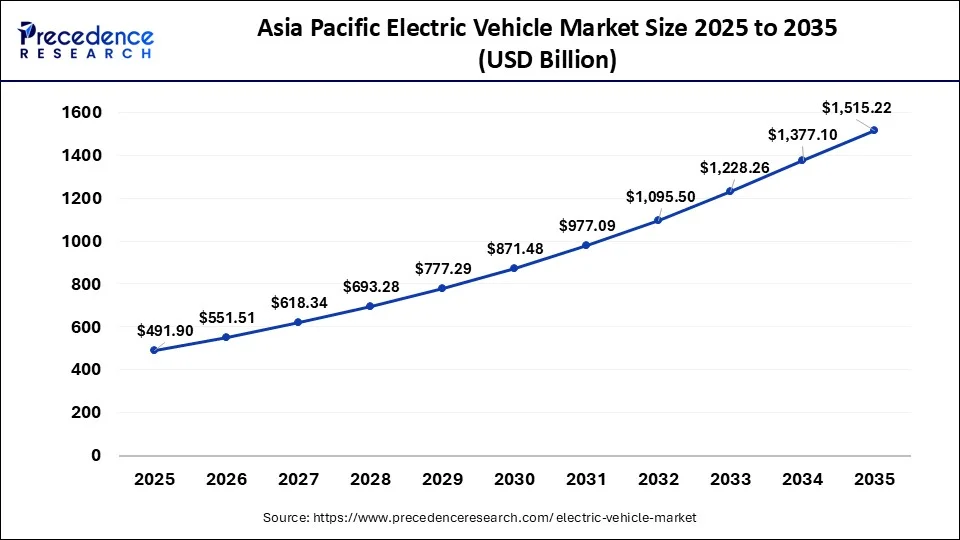
The Asia Pacific electric vehicle market size has been calculated at USD 491.90 billion in 2025 and is anticipated to reach approximately USD 1,515.22 billion by 2035. The EV industry is poised to grow at a double-digit CAGR of 11.91% from 2026 to 2035.
What Made Asia Pacific the Dominant Region in the Market?
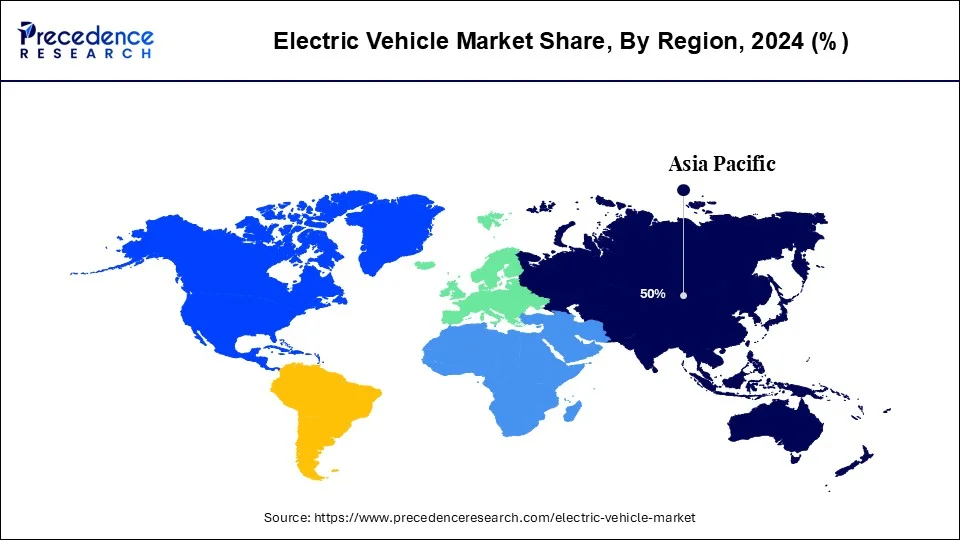
Asia Pacific dominated the electric vehicle market by holding the largest share in 2035. The region’s dominance is supported by strong government policies, extensive manufacturing capabilities, rapidly expanding charging infrastructure, and continuous advancements in battery technology. Major EV-producing countries, including China, Japan, South Korea, and India, are investing heavily in research, production capacity, and supply chain development. Government initiatives such as subsidies, tax incentives, and local manufacturing programs continue to accelerate EV adoption. Additionally, the integration of AI-powered battery management systems and vehicle technologies is enhancing battery performance, driving range, and overall vehicle efficiency.
North America: The Fastest-Growing Region
North America is expected to grow at the fastest CAGR over the forecast period, driven by increasing investments in advanced battery technologies, expanding charging infrastructure, and supportive government policies aimed at reducing transportation emissions. The region is witnessing significant research and development activities in areas such as solid-state batteries, lithium-sulfur batteries, and fast-charging technologies, which are expected to improve EV performance and accelerate adoption. Strategic collaborations among automakers, technology providers, and charging network operators are further supporting market expansion.
How is the Opportunistic Rise of Europe in the Electric Vehicle Market?
Europe is anticipated to witness significant growth during the forecast period, supported by stringent emission regulations, strong government incentives, and rising adoption of battery electric vehicles (BEVs). The region is becoming a major hub for EV innovation, battery production, and sustainable mobility solutions. Increasing demand for electric SUVs and compact EVs, along with ongoing investments in battery gigafactories and localized supply chains, is contributing to regional market expansion. Industry partnerships and advancements in charging infrastructure are further supporting the transition toward electrified transportation.
What Drives the Electric Vehicle Market in the MEA?
The market within the Middle East & Africa (MEA) is mainly driven by the increasing investments by governments and private companies in sustainable transportation and clean energy initiatives. Growing interest in EV manufacturing, battery production, and charging infrastructure development is creating new opportunities across the region. Several countries are investing in EV assembly facilities and battery manufacturing projects while also focusing on technologies designed to improve battery performance under extreme climatic conditions. These developments are expected to support the long-term growth of the regional market.
Why is the Electric Vehicle Market in Latin America Gaining Momentum?
The Latin American electric vehicle market is gaining momentum due to increasing environmental awareness, urbanization, and government efforts to reduce transportation-related emissions. Growing investments in renewable energy and clean mobility solutions are creating favorable conditions for EV adoption. The increasing use of electric commercial vehicles, buses, and passenger cars is expected to support long-term market growth across the region.
Statistical data for the Electric Vehicle Market
- 17 million electric cars were sold around the world in 2024. This was a number making up more than 20 percent of all car sales.
- In 2024, an extra 3.5 million electric cars were sold. This made the number of electric cars sold in 2024 more than the total number sold in 2020.
- Over 11 million electric cars were sold in China. This was half of all electric car sales worldwide.
- In Europe, electric cars made up around 20 percent of sales. Different countries in Europe had different results.
- In the U.S, electric car sales grew by 10 percent. Now than one in ten cars sold there is electric.
- By 2030, electric cars are expected to make up more than 40 percent of all car sales worldwide.
- In China, it is expected that 80 percent of all cars sold expected to be electric by 2030.
Market Competitive Landscape: Leading Companies and Strategies
The electric vehicle market is characterized by intense competition among established automotive manufacturers, emerging EV-focused companies, battery technology providers, and charging infrastructure developers. Market players are focusing on expanding EV portfolios, improving battery efficiency, reducing production costs, and developing advanced software-driven mobility solutions to strengthen their competitive position.
Leading companies are investing heavily in research and development to enhance battery range, charging speed, autonomous driving capabilities, and connected vehicle technologies. Strategic collaborations between automakers, semiconductor companies, battery manufacturers, and charging network operators are becoming increasingly important for accelerating EV adoption and building a sustainable mobility ecosystem.
Major EV manufacturers are expanding their global presence through new product launches, localized manufacturing facilities, and partnerships aimed at strengthening supply chains. Companies are also focusing on affordable EV models, premium electric vehicles, and commercial electric mobility solutions to address diverse consumer and industrial requirements.
Electric Vehicle Market Companies
- BYD Company Limited: BYD Company Limited is thus offering a comprehensive lineup of battery electric vehicles (BEVs) along with plug-in hybrids (PHEVs), featuring proprietary Blade Battery technology, e-Platform 3.0, as well as advanced DM-i hybrid systems. They aim for affordable, high-safety, and even high-efficiency electric transportation, thus spanning passenger cars to commercial buses and trucks, with operations in over 100 countries.
- Chevrolet Motor Company: Chevrolet provides a growing lineup of electric vehicles driven by the versatile Ultium battery platform, impacting long range, fast charging, and competitive pricing.
- Energica Motor Company S.p.A.: Energica Motor Company S.p.A. provides high-performance electric motorcycles and even advanced, proprietary EV powertrain technologies for both two-wheelers and a few electric mobility applications.
- Ford Motor Company: Ford Motor Company is investing $22 billion by 2025 in electric vehicles, aiming on popularizing icons with models such as the F-150 Lightning truck, Mustang Mach-E SUV, and even E-Transit van. They are shifting toward more affordable, smaller EVs through a new dedicated platform, targeting a $30,000 price point by 2027 to compete with Tesla and Chinese automakers.
Other Major Key Players
- Ampere Vehicles
- Hyundai Motor Company
- Benling India Energy and Technology Pvt Ltd
- BMW AG
- General Motors
- Hero Electric
- Karma Automotive
- Kia Corporation
Leader’s Announcements
- In January 2025, Tarun Garg, COO of Hyundai Motor India, announced 2025 to be a year of “big change” for the Indian electric car market. He assured Hyundai Motor India will play a critical role in driving adoption in the nascent yet fast-emerging EV space.
Investments
- In July 2025, the UK government announced £63 million to charge Britain’s EV infrastructure. The £25 million is used to expand cheaper at-home charging and focus on installing 100000 charging points. The £8 million is used for the electrification of medical fleets and ambulances. (Source: https://www.gov.uk)
- In June 2025, Tata Motors plans to invest up to $4 billion in electric vehicles over the next 5 years. The aim is to sustain the position of top electric vehicle manufacturer. (Source: https://www.business-standard.com)
- In December 2024, the UK’s BII is to invest $33.5 million in India’s electric vehicle companies. The institution would invest $3.5 million in Vecmocon for the EV component, $15 million in Everest Fleet, and $15 million in TI Clean Mobility for EV manufacturing. The investment focuses on offering affordable financial options and enhancing manufacturing capabilities. (Source: https://economictimes.indiatimes.com)
- In November 2024, Mahindra plans to invest Rs. 4500 crore for the development of electric vehicles, XEV 9e and BE 6e. The investment focuses on increasing 120000 units production capacity in the Chakan facility. (Source: https://auto.hindustantimes.com)
- In March 2015, JSW Group set out to raise Rs. 1487 crore for the development of a new unit in Maharashtra. The new facility has an annual production capacity of 5000 electric trucks and 10000 electric buses. The aim of projects is to support green mobility. (Source: https://www.autocarpro.in)
Recent Developments in the Electric Vehicle Market (2025–2026)
- In June 2026, the talk buzzing around on social media platforms for the Maruti eVitara 49 kWh is the major success of the Maruti Brand, accelerating the market footprint and building trust among customers and the brand for a long-fuelled journey. (Ref: https://www.team-bhp.com)
- In June 2026, MG Starlight 560 testing went viral on the Indian roads and was seen charging at the parking. This seems to be an open promotion of this new SUV’s commitment to introducing robust hybrids and PHEVs in the vast EV Industry. The new MG Starlight 560 will soon join the popular EV range of excellence. (Ref: https://www.carlelo.com)
- In June 2026, Mercedes-Benz India confirmed its preparation to extend its PHEV line-up due to the rising demand for conventional cars. The company also announced that if the demand keeps on increasing, the new technology in infinite models will be unveiled. (Ref: https://www.business-standard.com)
- In April 2026, Tata Motors expected to launch a new premium EV brand, Avinya, expected in late 2026 or early 2027, with a dedicated retail channel. Specific product and marketing details remain undisclosed. Avinya bridges the mass-market and luxury EV segments, utilizing JLR’s Electrified Modular Architecture (EMA), which also supports next-gen Range Rover and Land Rover models. (Source: https://www.indiacarnews.com )
- In April 2026, Hero Surge Future Mobility is set to launch the Hero Surge S32, India’s first 2-in-1 electric vehicle transforming between a two-wheeler and a three-wheeler. It has received type approval under the L2-5 category, announced by Union Minister Nitin Gadkari. (Source: https://www.evmechanica.com )
- In January 2025, Maruti Suzuki announced the launch of its first electric SUV, the e Vitara, at the Bharat Mobility Global Auto Expo. This launch is expected to be held till the end of April.
- On April 16, 2025, the title of 2025 World Electric Vehicle was given to the Hyundai INSTER at the globally renowned 2025 World Car Awards ceremony, held during the New York International Auto Show (NYIAS).
- On April 22, 2025, Renault announced the launch of two next-gen cars and two new SUVs based on a new platform.
Segment Covered in the Report
By Vehicle Type
- Scooters
- Motorcycles
- Three-Wheelers
- Passenger Cars
- Buses
- Trucks
By Propulsion Type
- Battery Electric Vehicle (BEV)
- Plug-in Hybrid Electric vehicle (PHEV)
- Fuel Cell Electric Vehicle (FCEV)
By Drive Type
- Front-wheel Drive (FWD)
- Rear-wheel Drive (RWD)
- All-wheel Drive (AWD)
By Vehicle Speed
- Less Than 100 MPH
- 100MPH to 125MPH
- Above 125 MPH
By Vehicle Class
- Low Priced
- Mid-Price
- High Price
By End Use
- Personal
- Commercial
By Geography
- North America
- Asia Pacific
- Europe
- Latin America
- Middle East & Africa
Check this Report too : Microfluidics Market
Get this report to explore global market size, share, CAGR, and trends, featuring detailed segmental analysis and an insightful competitive landscape overview @ https://www.precedenceresearch.com/sample/1009
You can place an order or ask any questions, please feel free to contact us at sales@precedenceresearch.com |+1 804 441 8440
