
 by
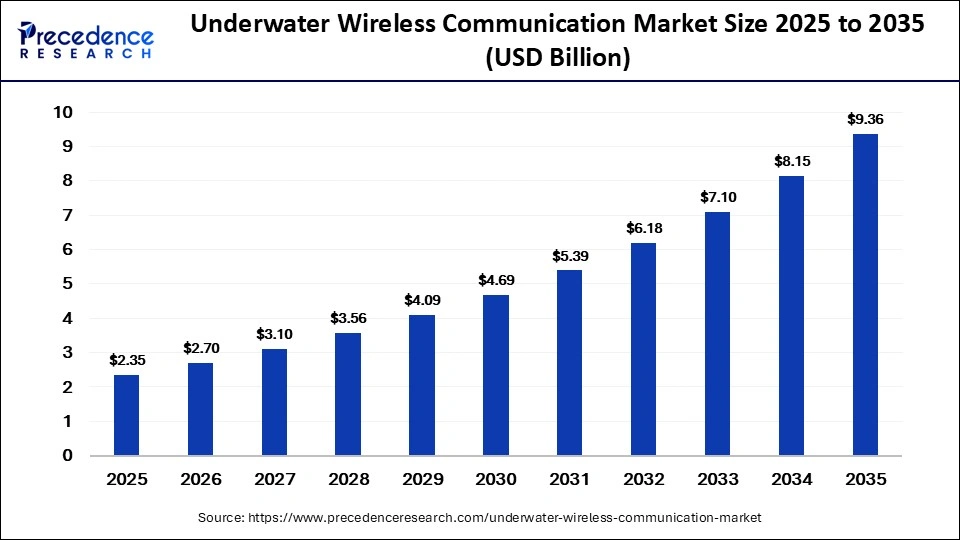
by The global underwater wireless communication market is projected to grow from USD 2.70 billion in 2026 to USD 9.36 billion by 2035, driven by rising investments in defense modernization, offshore energy, underwater sensor networks, autonomous underwater vehicles, and ocean monitoring technologies.
Read Also: AI Hallucination Detection Market
Underwater Wireless Communication Market Accelerates with Growing Demand for Smart Ocean Connectivity
Introduction
The increasing need for reliable underwater connectivity is reshaping marine operations worldwide. From defense surveillance and offshore energy exploration to environmental monitoring and autonomous underwater vehicles (AUVs), underwater wireless communication technologies are becoming indispensable for transmitting data in challenging underwater environments.
Traditional wired communication systems often face limitations related to deployment costs, maintenance requirements, and operational flexibility. As a result, industries are increasingly adopting advanced underwater wireless communication solutions that enable real-time data exchange, remote monitoring, and autonomous operations across oceans, lakes, and offshore facilities.
The emergence of the Internet of Underwater Things (IoUT), smart maritime infrastructure, and AI-powered marine systems is further accelerating the demand for robust underwater communication networks. Recent industry developments also highlight growing innovation in optical communication technologies capable of delivering significantly higher underwater data transmission speeds.
Market Overview
The global underwater wireless communication market was valued at USD 2.35 billion in 2025 and is expected to grow from USD 2.70 billion in 2026 to approximately USD 9.36 billion by 2035, registering a CAGR of 14.8% during the forecast period.
Market growth is being driven by increasing deployment of underwater sensor networks, growing defense investments, expansion of offshore oil & gas infrastructure, and rising adoption of autonomous underwater vehicles for surveillance, exploration, and monitoring applications. The broader underwater wireless communication industry is witnessing strong growth momentum globally as organizations seek real-time subsea connectivity solutions.
Understanding Underwater Wireless Communication
Underwater wireless communication enables data transmission between underwater devices without requiring physical cables.
Key communication technologies include:
- Acoustic Communication
- Optical Communication
- Radio Frequency (RF) Communication
- Electromagnetic Communication
- Hybrid Communication Systems
Each technology offers unique advantages depending on transmission distance, speed requirements, power consumption, and environmental conditions.
Acoustic communication remains the dominant technology due to its ability to support long-range underwater communication, while optical communication is gaining popularity for high-speed short-distance data transmission applications. Recent technological breakthroughs have demonstrated underwater optical communication speeds exceeding 5 Gbps in laboratory environments.
Impact of Artificial Intelligence on Underwater Communication
Artificial intelligence is playing an increasingly important role in improving underwater communication performance.
AI-powered systems help:
- Optimize signal transmission
- Reduce communication interference
- Enhance network reliability
- Improve autonomous navigation
- Enable predictive maintenance
- Strengthen underwater sensor networks
By analyzing environmental conditions and communication patterns, AI can dynamically adjust network parameters to improve connectivity and reduce power consumption.
Key Market Drivers
Growing Deployment of Underwater Sensor Networks
Governments, environmental agencies, and research institutions are increasingly deploying underwater sensor networks to monitor marine ecosystems, climate conditions, ocean currents, and pollution levels.
These sensor systems require reliable communication infrastructure capable of transmitting data in real time, creating strong demand for underwater wireless communication technologies.
Expansion of Defense and Maritime Security Programs
Naval modernization initiatives and maritime security programs are among the most significant growth drivers for the market.
Defense organizations worldwide are investing in:
- Underwater surveillance systems
- Anti-submarine warfare technologies
- Autonomous underwater vehicles
- Secure communication networks
- Underwater situational awareness platforms
Growing geopolitical tensions and increasing focus on maritime security continue to support market expansion.
Rising Offshore Oil & Gas Activities
The offshore energy sector relies heavily on underwater communication systems for infrastructure monitoring, inspection, maintenance, and operational management.
As exploration activities expand into deeper waters, demand for advanced underwater communication technologies continues to increase.
Growth of Autonomous Underwater Vehicles
AUVs are increasingly used for underwater mapping, surveillance, research, and inspection applications.
These systems require robust communication networks to:
- Exchange mission data
- Receive commands
- Coordinate operations
- Transmit sensor information
The growing deployment of underwater robotics is creating substantial opportunities for communication technology providers.
Emerging Market Trends
Rise of the Internet of Underwater Things (IoUT)
The Internet of Underwater Things is transforming underwater operations by connecting sensors, vehicles, monitoring stations, and communication networks into integrated ecosystems.
IoUT deployments are improving:
- Environmental monitoring
- Offshore asset management
- Marine research
- Defense surveillance
- Disaster prevention systems
This trend is expected to significantly boost market growth throughout the forecast period.
Development of Hybrid Communication Systems
Hybrid communication systems combine multiple technologies such as acoustic and optical communication to maximize performance.
These systems provide:
- Long-range connectivity
- High-speed data transmission
- Improved reliability
- Reduced latency
Hybrid architectures are becoming increasingly attractive for complex underwater missions.
Advancements in Optical Communication
Optical communication technologies are gaining momentum due to their ability to support ultra-high-speed underwater data transmission.
Recent innovations have demonstrated underwater optical communication speeds of up to 5.2 Gbps, enabling applications such as real-time video streaming, underwater drone operations, and advanced monitoring systems.
Segment Analysis
Acoustic Communication Dominates the Market
By technology, acoustic communication continues to account for the largest market share.
Its advantages include:
- Long transmission range
- High reliability
- Proven performance
- Broad deployment across industries
Acoustic systems remain the preferred choice for defense, research, and offshore applications.
Optical Communication Records Fastest Growth
The optical communication segment is expected to witness the fastest growth due to increasing demand for high-speed underwater data transfer and real-time communication capabilities. Advances in laser-based communication technologies are further strengthening segment growth prospects.
Underwater Sensor Networks Lead Network Type Segment
Underwater sensor networks represent a major share of market demand due to increasing adoption across environmental monitoring, marine research, offshore infrastructure monitoring, and defense surveillance applications.
Defense & Security Remains Largest Application Segment
The defense and security sector continues to generate the highest demand for underwater communication technologies due to increasing investments in maritime surveillance, naval modernization, and underwater warfare systems.
Regional Analysis
North America Maintains Market Leadership
North America remains the largest market due to:
- Significant defense spending
- Strong naval capabilities
- Advanced marine research infrastructure
- Offshore energy investments
The United States continues to drive innovation and adoption across underwater communication technologies.
Asia-Pacific Emerges as Fastest-Growing Region
Asia-Pacific is expected to register the highest growth rate during the forecast period.
Growth is supported by:
- Expanding maritime security initiatives
- Offshore exploration projects
- Growing defense budgets
- Increasing deployment of underwater drones
Countries such as China, India, Japan, and Australia are making substantial investments in underwater technologies.
Europe Strengthens Maritime Technology Investments
Europe continues to invest heavily in:
- Offshore wind energy projects
- Oceanographic research
- Maritime surveillance systems
- Smart port infrastructure
These investments are creating favorable conditions for underwater communication market growth.
Competitive Landscape
The underwater wireless communication market remains moderately fragmented, with companies focusing on technological innovation and strategic partnerships.
Major industry participants include:
- EvoLogics
- Teledyne Marine
- Sonardyne International
- Kongsberg Maritime
- L3Harris Technologies
- Subnero
- Nortek
- Saab
- Water Linked
- DSPComm
Market participants are investing heavily in advanced acoustic modems, optical communication systems, AI-powered networking platforms, and autonomous marine communication technologies.
Challenges Facing the Market
Despite strong growth prospects, several challenges remain:
- Limited underwater bandwidth
- Signal attenuation
- Environmental interference
- High deployment costs
- Energy consumption constraints
- Complex network management
Ongoing research and development efforts are focused on overcoming these technical limitations through innovative communication architectures and advanced signal-processing technologies.
Future Outlook
The future of underwater wireless communication appears highly promising as industries increasingly adopt connected underwater ecosystems.
Key growth opportunities will emerge from:
- Internet of Underwater Things deployments
- Autonomous marine systems
- Offshore renewable energy projects
- Smart ocean monitoring platforms
- AI-powered communication networks
- Advanced optical communication technologies
Continued innovation is expected to significantly improve communication speeds, reliability, and scalability over the coming decade.
Conclusion
The underwater wireless communication market is entering a period of significant expansion as organizations seek reliable and intelligent subsea connectivity solutions. Growing investments in defense modernization, offshore energy infrastructure, environmental monitoring, and autonomous underwater systems are creating strong demand across global markets.
With the market projected to reach USD 9.36 billion by 2035, underwater wireless communication technologies will play a vital role in enabling smarter, safer, and more efficient ocean operations. As advances in AI, optical communication, and IoUT ecosystems continue to accelerate, the industry is poised for sustained long-term growth.
Get a Sample Copy: https://www.precedenceresearch.com/sample/8509
For inquiries regarding discounts, bulk purchases, or customization requests, please contact us at sales@precedenceresearch.com
