
 by
by The global in vitro diagnostics (IVD) market was valued at USD 104.01 billion in 2025 and is projected to reach approximately USD 135.76 billion by 2035, expanding at a CAGR of 2.7% from 2026 to 2035. Market growth is primarily driven by the increasing need for early disease detection, rising awareness of preventive healthcare, and growing adoption of advanced diagnostic technologies that enable faster and more accurate testing.
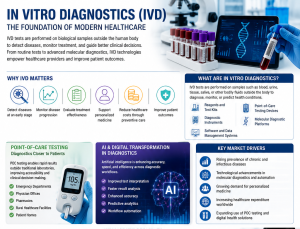
What is In Vitro Diagnostics (IVD)?
In vitro diagnostics refer to medical tests conducted on biological samples such as blood, urine, tissues, or other bodily fluids outside the human body. These tests help healthcare professionals diagnose diseases, assess patient health, monitor therapies, and predict disease risks.
IVD products include:
- Diagnostic reagents
- Laboratory instruments
- Testing kits
- Molecular diagnostic systems
- Clinical laboratory software
- Point-of-care diagnostic devices
Get Sample: https://www.precedenceresearch.com/sample/1130
Why Demand for Diagnostic Testing is Growing
The demand for diagnostic testing has increased significantly over the past decade as healthcare systems focus more on early disease detection, preventive care, and personalized treatment. Diagnostic tests help identify diseases before symptoms become severe, allowing healthcare providers to intervene early and improve patient outcomes.
One of the major factors driving demand is the growing prevalence of chronic diseases such as diabetes, cardiovascular disorders, kidney diseases, and cancer. These conditions require regular monitoring and testing to assess disease progression and treatment effectiveness. As the global population ages, the number of individuals requiring routine health assessments and diagnostic services continues to rise.
How AI is Transforming Diagnostics
Artificial Intelligence (AI) is revolutionizing the field of diagnostics by improving the speed, accuracy, and efficiency of disease detection. AI-powered systems can analyze vast amounts of medical data, identify patterns, and support healthcare professionals in making informed clinical decisions.
One of the most impactful applications of AI is medical image analysis. AI algorithms can examine radiology images, pathology slides, and other diagnostic data to identify abnormalities that may be difficult for the human eye to detect. This capability helps improve diagnostic accuracy and supports earlier disease detection.
In pathology and laboratory medicine, AI can automate routine tasks and analyze complex datasets more efficiently. Automated systems reduce human error, improve laboratory productivity, and enable healthcare providers to process larger volumes of diagnostic tests.
Emerging Trends in the In Vitro Diagnostics Market
AI-Powered Diagnostics
Artificial intelligence is transforming diagnostic workflows by:
- Enhancing image analysis
- Supporting disease prediction
- Reducing diagnostic errors
- Improving laboratory efficiency
AI-enabled platforms are particularly beneficial in oncology, pathology, and radiology diagnostics.
Growth of Point-of-Care Testing
Point-of-care (POC) testing allows healthcare providers to perform diagnostic tests near the patient instead of sending samples to centralized laboratories.
Benefits include:
- Faster results
- Improved patient convenience
- Better clinical decision-making
- Reduced hospital burden
POC testing has become a major growth area within the IVD industry.
Rise of Home-Based Diagnostics
Consumer demand for convenient healthcare solutions has fueled growth in:
- Blood glucose monitoring kits
- Pregnancy tests
- Infectious disease self-testing
- Genetic testing kits
The home care segment is expected to experience substantial growth throughout the forecast period.
Integration of Digital Health Platforms
Connected diagnostic devices can now transmit results directly to healthcare providers through digital platforms.
This integration supports:
- Remote patient monitoring
- Telemedicine
- Real-time health tracking
- Improved patient engagement
How In Vitro Diagnostics Helps Improve Patient Care
In Vitro Diagnostics (IVD) plays a vital role in improving patient care by providing healthcare professionals with accurate information about a patient’s health condition. These diagnostic tests analyze biological samples such as blood, urine, tissues, and other bodily fluids to detect diseases, monitor treatment progress, and guide clinical decisions.
One of the most significant benefits of IVD is early disease detection. Conditions such as cancer, diabetes, and infectious diseases can often be identified before symptoms become severe. Early diagnosis allows physicians to begin treatment sooner, improving survival rates and reducing healthcare costs.
Read More: 2-Methoxy-2-Methylheptane Market
In Vitro Diagnostics Market Segment Analysis
By Product
Reagents
- Reagents currently dominate the market because they are essential components of nearly every diagnostic test.
- Growing test volumes across hospitals and laboratories continue to drive demand for diagnostic reagents.
Instruments
- The instruments segment is expected to witness significant growth due to increasing adoption of automated and AI-enabled diagnostic systems.
- Modern diagnostic instruments improve throughput, accuracy, and laboratory efficiency.
By Technology
Molecular Diagnostics
Molecular diagnostics remains the leading technology segment due to its ability to detect diseases at the genetic and molecular level.
Applications include:
- Infectious disease testing
- Oncology diagnostics
- Genetic disorder screening
- Companion diagnostics
- Immunoassays
Immunoassay technologies continue gaining traction because of their high sensitivity and broad application in disease detection and monitoring.
By Application
Infectious Diseases
- The infectious disease segment currently accounts for the largest share of diagnostic testing due to ongoing surveillance and disease management requirements.
Oncology
- Cancer diagnostics is projected to experience the fastest growth during the forecast period.
Advancements in:
- Liquid biopsies
- Biomarker testing
- AI-assisted pathology
- Genomic profiling
are transforming cancer diagnosis and treatment planning.
By End User
Standalone Laboratories
- Independent diagnostic laboratories continue to represent a significant market segment due to high testing volumes and specialized capabilities.
Hospitals
- Hospitals are expected to experience strong growth as healthcare facilities increasingly adopt advanced diagnostic technologies and automated testing systems.
In Vitro Diagnostics Market Regional Analysis
North America
North America leads the global IVD market with approximately 42% market share. Factors supporting regional growth include:
- Advanced healthcare infrastructure
- High healthcare spending
- Strong presence of major diagnostic companies
- Rising adoption of personalized medicine
- High prevalence of chronic diseases
The United States remains the largest contributor to regional revenue.
Europe
Europe represents a significant market driven by:
- Extensive healthcare coverage
- Increasing adoption of molecular diagnostics
- Government support for early disease detection
- Growing investment in precision medicine
Countries such as Germany, the United Kingdom, and France continue to expand diagnostic capabilities.
Asia-Pacific
Asia-Pacific is emerging as one of the fastest-growing regions due to:
- Expanding healthcare infrastructure
- Growing healthcare expenditure
- Large patient populations
- Increasing awareness of preventive healthcare
China, India, Japan, and South Korea are major growth contributors.
Latin America and Middle East & Africa
- These regions are witnessing increased investments in healthcare modernization, laboratory infrastructure, and diagnostic accessibility, creating significant growth opportunities.
Competitive Landscape
The global IVD market is highly competitive, with companies focusing on technological innovation, strategic partnerships, acquisitions, and geographic expansion.
- Major Market Players
- Roche Diagnostics
- Abbott Laboratories
- Siemens Healthineers
- Danaher Corporation
- Thermo Fisher Scientific
- Sysmex Corporation
- bioMérieux
- QIAGEN
- Bio-Rad Laboratories
- Hologic Inc.
These organizations continue investing heavily in molecular diagnostics, automation, AI integration, and point-of-care solutions.
The Future of Healthcare Diagnostics
The future of healthcare diagnostics is being shaped by rapid technological advancements, increasing demand for personalized medicine, and the growing need for faster, more accurate disease detection. As healthcare systems worldwide focus on preventive care and early intervention, diagnostic technologies are becoming more sophisticated, accessible, and patient-centered.
One of the most significant developments is the integration of artificial intelligence (AI) into diagnostic workflows. AI-powered tools can analyze medical images, laboratory data, and patient records with remarkable speed and accuracy, helping healthcare professionals identify diseases earlier and make more informed treatment decisions. These technologies are expected to reduce diagnostic errors, improve efficiency, and support better patient outcomes.
You can place an order or ask any questions. Please feel free to contact us at sales@precedenceresearch.com |+1 804 441 9344
