
 by
by The global machine automation controller market is witnessing strong momentum as industries increasingly embrace smart manufacturing technologies, AI-powered production systems, and industrial automation infrastructure. The rapid expansion of Industry 4.0 initiatives, combined with increasing investments in robotics, predictive maintenance, and connected factory ecosystems, is significantly driving the adoption of machine automation controllers across multiple industries.
According to Precedence Research, the global machine automation controller market size was valued at USD 45.61 billion in 2025 and is projected to increase from USD 49.04 billion in 2026 to approximately USD 94.18 billion by 2035, growing at a CAGR of 7.52% from 2026 to 2035. Rising demand for improved productivity, operational accuracy, lower maintenance costs, and enhanced industrial safety is fueling market expansion globally.
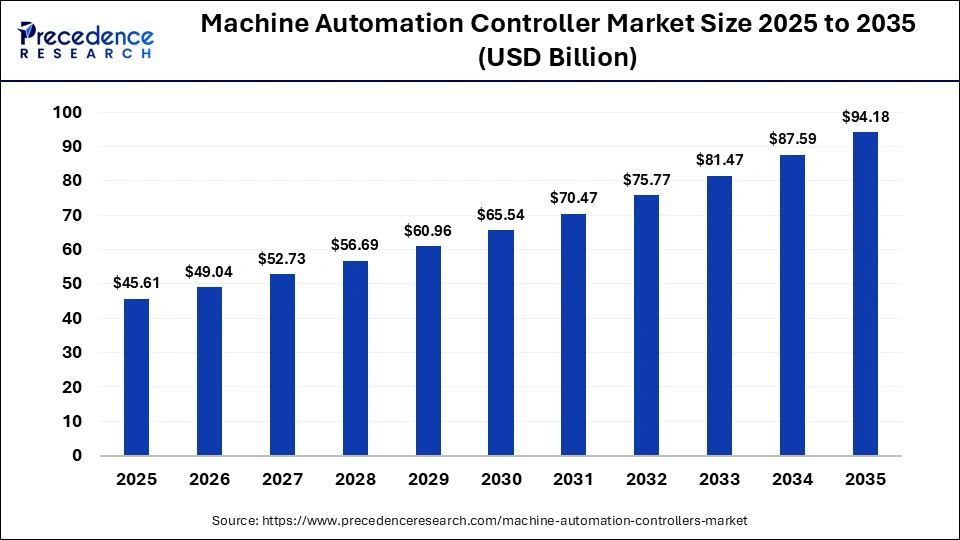
Machine automation controllers are increasingly being integrated into manufacturing systems, smart buildings, automated production lines, process industries, and energy management infrastructure. These advanced systems combine high-speed operational performance with real-time analytics, reliability, and intelligent process control capabilities, making them essential components of next-generation industrial automation ecosystems.
Read Also: Fantasy Sports Market
Quick Insights: What Are the Key Highlights of the Machine Automation Controller Market?
- Asia-Pacific dominated the global market with 40% market share in 2025 due to strong manufacturing and industrial automation investments.
- North America is projected to witness the fastest CAGR during the forecast period because of rising AI-enabled manufacturing modernization initiatives.
- The distributed control systems (DCS) segment held the largest market share in 2025 owing to superior scalability and operational reliability.
- Programmable automation controllers (PACs) are expected to emerge as the fastest-growing controller category through 2035.
- By machine operation type, discrete manufacturing accounted for the highest market share in 2025 due to growing automation across automotive and electronics sectors.
- The batch processing segment is anticipated to witness the fastest growth during the forecast period.
- Oil and gas emerged as the leading end-use industry in 2025 because of increasing deployment of automation systems across exploration and refining operations.
- Power generation and utilities are expected to witness substantial growth due to rising investments in smart grid infrastructure and predictive maintenance systems.
- Major industry participants include Siemens AG, ABB Ltd., Schneider Electric SE, Rockwell Automation, Mitsubishi Electric Corporation, Honeywell International Inc., Emerson Electric Co., Omron Corporation, and FANUC Corporation.
How Is Artificial Intelligence Transforming the Machine Automation Controller Market?
Artificial intelligence is becoming a foundational technology in industrial automation systems. AI-enabled machine automation controllers are capable of collecting high-fidelity operational data directly from machines and production systems to support predictive maintenance, process optimization, and real-time decision-making.
Machine learning algorithms integrated within automation controllers help manufacturers rapidly identify equipment irregularities, improve production efficiency, and reduce unexpected downtime. AI-powered controllers can instantly analyze machine-level operational parameters and initiate corrective actions before production disruptions occur.
Additionally, AI integration enables advanced monitoring capabilities across high-speed production environments where even minor quality defects can significantly impact manufacturing efficiency. By leveraging AI-driven automation systems, industries can optimize production workflows, improve quality assurance, and enhance operational reliability across manufacturing facilities.
What Are the Major Growth Drivers of the Machine Automation Controller Market?
Why Is Industry 4.0 Accelerating Market Expansion?
The rapid global adoption of Industry 4.0 technologies is one of the strongest growth drivers for machine automation controllers. Manufacturers are increasingly investing in connected factories, industrial IoT platforms, cloud-based manufacturing systems, and AI-powered automation infrastructure to improve productivity and operational efficiency.
How Is Robotics Integration Supporting Market Growth?
Industrial robots require advanced automation controllers capable of managing precision operations, synchronized machine movement, and real-time communication between manufacturing systems. Increasing robotics adoption across automotive, electronics, aerospace, and packaging industries is substantially boosting market demand.
Why Are Companies Prioritizing Energy-Efficient Automation?
The growing focus on sustainability and energy efficiency is encouraging industries to adopt intelligent automation systems capable of reducing power consumption while maximizing operational output. Smart automation controllers help optimize industrial processes while supporting environmental compliance goals.
How Is Cybersecurity Influencing Automation Investments?
As manufacturing environments become increasingly connected through industrial IoT networks, cybersecurity has emerged as a critical priority. Companies are investing in secure automation architectures and intelligent controllers capable of protecting operational systems against cyber threats and data breaches.
What Opportunities Are Emerging in the Machine Automation Controller Market?
Can Smart Factories Unlock Long-Term Market Opportunities?
Yes. Smart factories are expected to remain one of the most important growth opportunities for automation controller providers. Connected manufacturing environments require intelligent controllers capable of supporting machine-to-machine communication, real-time analytics, and autonomous operational coordination.
How Is Edge Computing Transforming Industrial Automation?
Edge computing is enabling manufacturers to process operational data closer to production systems instead of relying entirely on centralized cloud infrastructure. This improves latency, strengthens data security, and enables real-time industrial decision-making in mission-critical environments.
Will Autonomous Manufacturing Create Future Demand?
The rise of autonomous production systems, AI-enabled robotics, and self-optimizing industrial processes is expected to create significant demand for next-generation automation controllers with advanced analytics and intelligent operational capabilities.
Which Regions Are Leading the Machine Automation Controller Market?
Why Did Asia-Pacific Dominate the Market?
Asia-Pacific accounted for the largest market share in 2025 due to strong manufacturing activity across China, Japan, South Korea, Taiwan, and ASEAN economies. The region benefits from large-scale investments in semiconductor manufacturing, industrial robotics, automotive production, and smart factory deployment.
Government-led industrial modernization initiatives are further accelerating automation infrastructure investments throughout the region.
China Market Trends
China continues to lead regional market growth because of expanding semiconductor manufacturing, EV production, and AI-powered automation investments. Chinese manufacturers are aggressively deploying intelligent production systems to improve global competitiveness and production efficiency.
Companies such as BYD and CATL are significantly increasing automation deployment to support large-scale EV battery production expansion.
Why Is North America Growing Rapidly in the Machine Automation Controller Market?
North America is expected to witness the fastest CAGR during the forecast period owing to increasing investments in advanced manufacturing modernization and AI-enabled industrial automation infrastructure.
U.S. Market Trends
The United States remains a major innovation hub for industrial automation technologies, particularly across aerospace, defense, automotive, and industrial manufacturing sectors. The increasing adoption of AI-powered edge computing systems is strengthening the country’s automation ecosystem.
Organizations are heavily investing in research and development to optimize AI-driven algorithms for process automation and quality assurance.
Which Segments Are Driving Revenue Growth Across the Market?
Why Did the Distributed Control Systems (DCS) Segment Dominate the Market?
The distributed control systems (DCS) segment held the dominant market share in 2025 because of its superior scalability, reliability, and real-time operational monitoring capabilities.
DCS platforms distribute control functions across multiple operational nodes, reducing the risk of single-point failures while improving industrial process safety and reliability. These systems are widely used across process-intensive industries including oil & gas, chemicals, pharmaceuticals, and power generation.
Why Are Programmable Automation Controllers (PACs) Growing Rapidly?
Programmable automation controllers are projected to witness the fastest growth during the forecast period because they combine advanced control functions, robust networking capabilities, enterprise-level data integration, and interoperability within compact controller systems.
PACs are becoming increasingly important in Industry 4.0 environments requiring intelligent automation and advanced process control capabilities.
Why Did Discrete Manufacturing Lead the Machine Operation Type Segment?
The discrete manufacturing segment accounted for the highest market share in 2025 due to growing automation across automotive, aerospace, electronics, industrial equipment, and medical device manufacturing sectors.
Discrete manufacturing operations increasingly rely on digital production systems, robotics, and industrial automation software to improve production flexibility, product quality, and operational efficiency.
Why Is Batch Processing Witnessing Strong Growth?
The batch processing segment is expected to expand rapidly because of its operational flexibility and ability to support multiple product variations within a single production environment. Manufacturers are increasingly adopting batch processing automation systems to improve efficiency while responding to changing customer requirements.
Why Did the Oil and Gas Segment Dominate the End-Use Industry Category?
The oil and gas industry held the largest market share in 2025 due to extensive reliance on distributed control systems and intelligent automation technologies across exploration, production, refining, and distribution operations.
Operators are increasingly integrating IoT-enabled sensors, predictive maintenance systems, and AI-powered automation technologies to improve operational efficiency while reducing workforce-related risks and downtime.
How Is the Power Generation Sector Emerging as a High-Growth Segment?
The power generation and utilities segment is projected to witness significant growth owing to increasing adoption of automation controllers for smart grid operations, predictive maintenance, load forecasting, and fault detection systems.
Automation controllers help improve operational stability, reduce human error, and enhance the reliability of power infrastructure systems.
What Recent Developments Are Reshaping the Machine Automation Controller Industry?
Nexus AI Students Introduce AI-Based PLC Programming Platform
In March 2026, a group of Indian students from Nexus AI developed an AI-powered platform capable of simplifying industrial PLC programming using natural language instructions. The innovation won the Gold Cup at the Mitsubishi Electric Cup and highlighted the growing role of AI in industrial automation.
Rockwell Automation Expands Controller Portfolio
In October 2025, Rockwell Automation launched Allen-Bradley Micro820 L20E controllers designed to improve automation performance, simplify integration, and accelerate industrial commissioning processes.
Trio Motion Technology Launches Advanced Motion PLC Systems
In September 2025, Trio Motion Technology introduced new Motion PLC controllers capable of delivering high-performance motion control functionality through EtherCAT integration and advanced I/O expansion capabilities.
What Challenges Are Limiting Market Growth?
Despite strong market potential, high implementation costs remain a major challenge, particularly for small and medium-sized manufacturers. Advanced automation systems require significant investments in hardware, software integration, workforce training, and cybersecurity infrastructure.
Additionally, workforce displacement concerns and operational resistance toward automation adoption may slow implementation across certain industries and regions.
Case Study: How Smart Automotive Factories Are Driving Automation Controller Adoption
Leading automotive manufacturers are increasingly deploying AI-enabled machine automation controllers across robotic assembly lines, welding systems, conveyor operations, and predictive maintenance platforms.
Industrial IoT-enabled automation controllers provide real-time operational visibility and enable automated process optimization, helping manufacturers reduce downtime, improve product quality, and maximize operational efficiency.
Conclusion: Why Is the Machine Automation Controller Market Entering a New Era of Smart Manufacturing?
The machine automation controller market is entering a transformative growth phase fueled by Industry 4.0 expansion, industrial AI integration, robotics deployment, and smart factory investments worldwide.
As manufacturers continue prioritizing productivity optimization, predictive maintenance, operational safety, and autonomous production systems, intelligent machine automation controllers are expected to become critical technologies supporting the next generation of industrial automation ecosystems.
Get a Sample Copy: https://www.precedenceresearch.com/sample/8228
For inquiries regarding discounts, bulk purchases, or customization requests, please contact us at [email protected]
