
 by
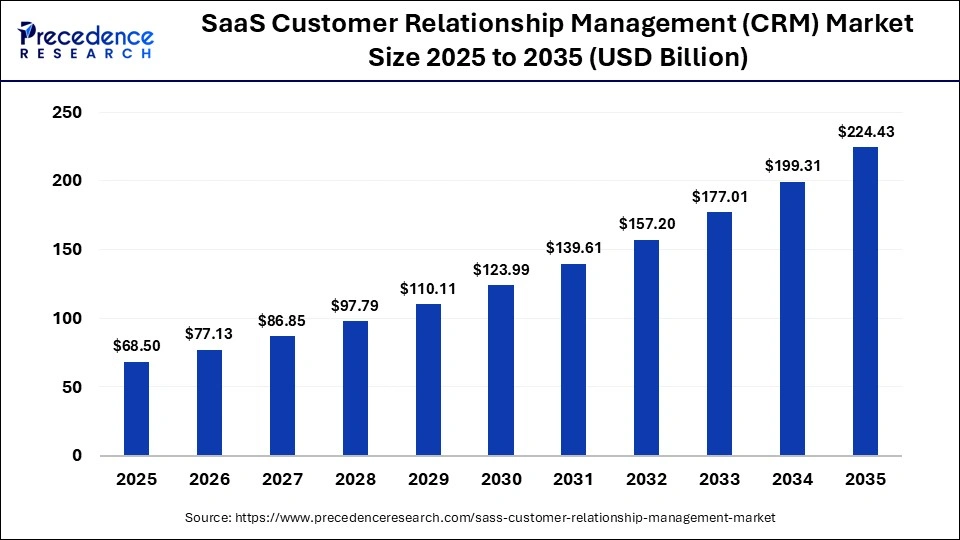
by The global SaaS Customer Relationship Management market is witnessing rapid transformation as organizations prioritize customer-centric strategies and digital engagement. The market was valued at USD 68.50 billion in 2025 and is projected to grow from USD 77.13 billion in 2026 to USD 224.43 billion by 2035, expanding at a CAGR of 12.60% during the forecast period.
The increasing need for personalized customer experiences, combined with the widespread adoption of cloud computing and automation technologies, is driving demand for SaaS CRM platforms. These solutions are enabling businesses to centralize customer data, streamline operations, and enhance decision-making across sales, marketing, and service functions.
Read Also: AI Ethics and Governance Solutions Market
Quick Insights
The SaaS CRM market generated USD 68.50 billion in 2025 and is expected to reach USD 224.43 billion by 2035, growing at a CAGR of 12.60%. North America dominated with 38% share, while Asia Pacific is projected to grow at the fastest CAGR of 15.5%. Sales force automation led with 30% share, public cloud deployment accounted for 70%, large enterprises held 60%, and retail & e-commerce contributed the highest share at 25%.
Why is SaaS CRM Becoming the Core of Digital Business Strategy?
Businesses today are shifting from transactional operations to relationship-driven models where customer experience is a key differentiator. SaaS CRM platforms provide a unified system to manage customer interactions, sales pipelines, and marketing campaigns across multiple touchpoints.
With increasing digitalization, organizations are leveraging CRM tools to gain real-time insights into customer behavior, improve engagement, and drive long-term loyalty. The ability to access data anytime, anywhere through cloud-based systems is making SaaS CRM a foundational component of modern enterprise architecture.
How is Artificial Intelligence Revolutionizing CRM Platforms?
Artificial intelligence is transforming SaaS CRM from a data management tool into an intelligent decision-making platform. AI-powered CRM systems enable predictive analytics, automated workflows, and real-time customer insights, helping businesses optimize their strategies.
These platforms can forecast customer behavior, automate lead scoring, and deliver personalized recommendations, allowing businesses to move from reactive to proactive engagement. As AI adoption grows, CRM systems are becoming more intuitive, efficient, and value-driven.
What are the Key Growth Drivers of the Market?
The rising focus on customer experience is a major driver of market growth. Businesses are investing in CRM solutions to enhance customer engagement, improve service delivery, and strengthen relationships.
Another key factor is the rapid adoption of cloud computing. SaaS CRM solutions offer scalability, cost efficiency, and easy integration with existing enterprise systems, making them highly attractive for organizations of all sizes.
What Trends and Opportunities are Shaping the Market?
Is Omnichannel Engagement Redefining CRM Strategies?
Yes, CRM platforms are integrating multiple communication channels such as email, social media, chat, and voice to provide seamless customer experiences across all touchpoints.
Are Industry-Specific CRM Solutions Gaining Momentum?
Absolutely. Vendors are increasingly offering tailored CRM solutions designed for specific industries such as healthcare, retail, and finance, enabling more customized workflows and compliance features.
Is AI-Driven Automation Unlocking New Growth Opportunities?
Yes, AI-powered CRM platforms are enabling businesses to automate operations, reduce manual workloads, and identify new revenue opportunities through advanced analytics.
Regional Analysis
North America dominated the SaaS CRM market in 2025, driven by strong adoption of cloud technologies, high IT spending, and the presence of leading vendors.
Asia Pacific is expected to grow at the fastest rate, supported by rapid digitalization, expanding e-commerce ecosystems, and increasing adoption among SMEs in countries such as India and China.
Europe also holds a significant share, driven by growing investments in digital transformation and customer engagement solutions.
Segmental Analysis
By Solution Type
| Solution | 2025 Share | Growth Trend |
|---|---|---|
| Sales Force Automation | 30% | Dominant |
| Customer Service & Support | 25% | Strong Growth |
| Marketing Automation | 20% | Growing |
| Customer Experience Management | 15% | Fastest Growing |
| Partner Relationship Management | 10% | Stable |
Sales force automation dominates due to its ability to streamline sales processes and improve efficiency, while CXM platforms are witnessing the fastest growth due to increasing demand for personalized customer experiences.
By Deployment Model
| Deployment | 2025 Share | Growth Trend |
|---|---|---|
| Public Cloud | 70% | Leading |
| Private Cloud | 20% | Stable |
| Hybrid | 10% | Growing |
Public cloud dominates due to scalability, lower costs, and ease of deployment, making it ideal for fast-growing businesses.
By Organization Size
| Organization | 2025 Share | Growth Trend |
|---|---|---|
| Large Enterprises | 60% | Dominant |
| SMEs | 40% | Fastest Growing |
SMEs are expected to grow rapidly due to increasing adoption of affordable cloud-based CRM solutions.
By Industry Vertical
| Industry | 2025 Share | Growth Trend |
|---|---|---|
| Retail & E-commerce | 25% | Dominant |
| IT & Telecom | 20% | Strong Growth |
| BFSI | 15% | Stable |
| Healthcare | 10% | Growing |
| Media & Entertainment | 10% | Fastest Growing |
| Manufacturing | 10% | Moderate |
| Government | 10% | Stable |
Retail leads due to high customer interaction volumes and the need for personalized engagement strategies.
Competitive Landscape and Key Companies
The SaaS CRM market is highly competitive, with major players focusing on AI integration, automation, and cloud innovation. Key companies include:
- Salesforce, Inc.
- Microsoft Corporation
- Oracle Corporation
- SAP SE
- Zoho Corporation
- HubSpot, Inc.
- Freshworks Inc.
- Zendesk, Inc.
These companies are investing heavily in AI-driven CRM platforms, predictive analytics, and automation technologies to enhance customer engagement and maintain competitive advantage.
What Challenges Could Impact Market Growth?
Are Data Security and Privacy Concerns Limiting Adoption?
Yes, ensuring data security and compliance with regulations remains a major challenge for cloud-based CRM platforms.
Is Integration with Legacy Systems Complex?
Integration challenges with existing enterprise systems can slow down adoption, particularly for large organizations with complex IT infrastructures.
Case Study: AI-Powered CRM in Retail
Retail companies leveraging AI-driven SaaS CRM platforms have significantly improved customer engagement and conversion rates. By using predictive analytics and personalized marketing, businesses are able to enhance customer experiences and drive revenue growth.
Conclusion
The SaaS CRM market is evolving into a central pillar of digital transformation strategies worldwide. With the integration of AI, cloud computing, and advanced analytics, the market is poised for substantial growth through 2035, enabling organizations to deliver superior customer experiences and drive long-term success.
Get Sample Copy: https://www.precedenceresearch.com/sample/8348
For inquiries regarding discounts, bulk purchases, or customization requests, please contact us at sales@precedenceresearch.com
