
 by
by The aviation industry is rapidly transitioning toward intelligent, data-driven platforms where real-time decision-making is critical. At the center of this transformation lies the aviation mission computer system—an advanced computing unit that integrates and processes data from multiple onboard systems.
The global aviation mission computer system market was valued at USD 4.80 billion in 2025 and is projected to grow from USD 5.13 billion in 2026 to approximately USD 9.35 billion by 2035, expanding at a CAGR of 6.90%.
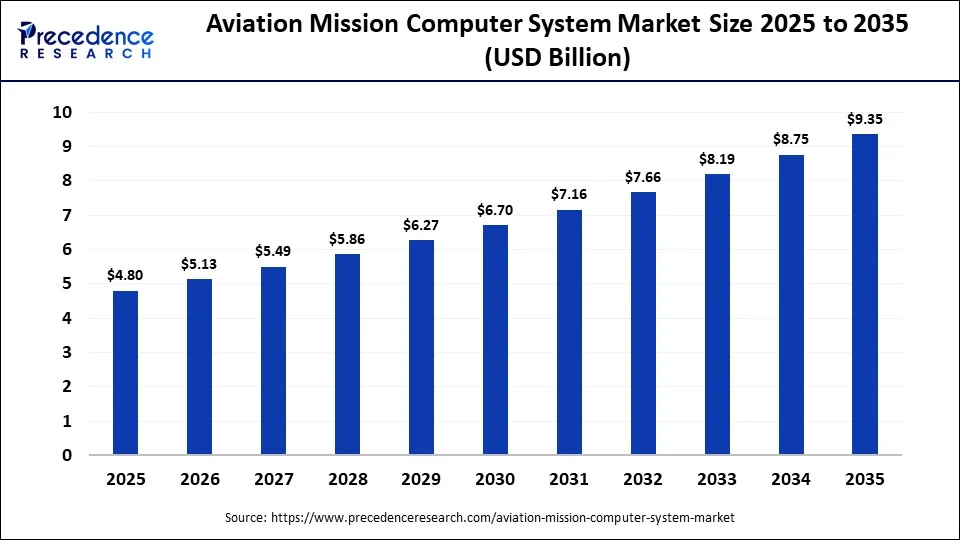
This growth is fueled by increasing defense investments, rising adoption of unmanned aerial vehicles (UAVs), and the need for enhanced situational awareness in modern aviation.
Read Also: Aviation Test Equipment Market
Quick Insights: What Are the Key Market Highlights?
The market is expected to nearly double, reaching USD 9.35 billion by 2035 from USD 4.80 billion in 2025.
North America dominated the market with a 40% share, supported by strong defense infrastructure and technological leadership.
Asia Pacific is projected to grow at the fastest CAGR of 8.5% due to increasing fleet modernization and aviation expansion.
Fighter aircraft accounted for 35% of the platform segment, while UAVs are the fastest-growing segment.
Mission management computers led the system type segment with a 30% share, reflecting their critical role in aircraft operations.
What is an Aviation Mission Computer System and Why Is It Critical?
An aviation mission computer system is a centralized embedded computing platform that acts as the “brain” of an aircraft. It integrates inputs from sensors, radar, navigation systems, and communication networks to deliver real-time situational awareness and mission-critical decision-making.
These systems enable:
- Multi-sensor data fusion
- Navigation and flight management
- Threat detection and response
- Weapon system coordination
- Real-time mission execution
They are essential for both military and advanced commercial aircraft, ensuring efficiency, safety, and operational success.
AI Role in the Market: How is Artificial Intelligence Transforming Mission Computing?
Artificial intelligence is significantly enhancing the capabilities of mission computer systems by enabling faster and more accurate data processing. AI algorithms analyze vast amounts of sensor data in real time, improving threat detection, navigation accuracy, and mission planning.
Additionally, AI reduces pilot workload by automating complex tasks and enabling semi-autonomous and autonomous operations. This transformation is making mission systems more adaptive, intelligent, and efficient.
Market Growth Factors: What is Driving Market Expansion?
Why Is UAV Adoption Increasing Demand?
The growing use of UAVs for surveillance, reconnaissance, and combat operations is driving demand for compact and high-performance mission computers.
How Are Defense Modernization Programs Fueling Growth?
Governments worldwide are investing in advanced avionics and mission systems to enhance military capabilities and operational readiness.
Why Is Real-Time Data Processing Critical?
Modern aviation requires instantaneous decision-making, increasing the need for high-performance computing systems.
How Does Digital Transformation Impact Aviation?
The integration of advanced avionics, sensors, and communication systems is increasing aircraft complexity, necessitating more sophisticated computing solutions.
Opportunities & Trends: What’s Shaping the Future of Mission Computing?
Are Open Architecture Systems the Future of Avionics?
Modular open systems architecture (MOSA) is gaining traction as it allows easier upgrades, improved interoperability, and reduced lifecycle costs.
Can AI Enable Autonomous Flight Operations?
AI-powered mission computers are enabling autonomous navigation and mission execution, reducing human intervention.
Is Hardware Miniaturization Driving Innovation?
Advancements in compact and high-performance processors are enabling more powerful computing capabilities within smaller systems.
How Is Edge Computing Enhancing Performance?
Edge computing allows data processing directly on the aircraft, reducing latency and improving real-time decision-making.
Segmentation Analysis: Where Are the Key Revenue Streams?
By Platform
- Fighter aircraft: 35% share
- UAVs: fastest-growing segment
- Transport aircraft, helicopters, and special mission aircraft contribute significantly
By System Type
- Mission management computers: 30% share
- Flight control & navigation systems: 25%
- Avionics data processing units: 25%
- Weapon system computers: fastest-growing segment
By Technology
- Embedded computing systems: 35% share
- Open architecture systems: growing rapidly
- AI-enabled mission computing: fastest-growing segment
By Application
- Combat & weapon management: 30% share
- Surveillance & reconnaissance: fastest-growing
- Navigation, communication, and electronic warfare systems also contribute
By End-Use
- Defense aviation: 75% share
- Commercial aviation and homeland security sectors are expanding steadily
Regional Analysis: Which Regions Are Leading the Market?
Why Does North America Dominate?
North America leads the market due to strong defense spending, advanced aerospace manufacturing, and early adoption of AI-driven avionics technologies.
How Strong is Europe’s Position?
Europe holds a significant share supported by collaborative defense programs and innovation in aerospace technologies.
Why is Asia Pacific the Fastest-Growing Region?
Asia Pacific is expanding rapidly due to rising air traffic, fleet expansion, and increasing defense investments.
Competitive Landscape: Who Are the Key Players Driving Innovation?
Leading companies in the aviation mission computer system market include:
- Honeywell International Inc.
- BAE Systems plc
- Thales Group
- RTX Corporation
- Northrop Grumman Corporation
- Lockheed Martin Corporation
- Leonardo S.p.A.
- Elbit Systems Ltd.
- L3Harris Technologies, Inc.
- Curtiss-Wright Corporation
These companies are focusing on AI integration, modular architectures, and high-performance computing to strengthen their market positions.
Challenges: What Could Restrain Market Growth?
Despite strong growth prospects, the market faces several challenges:
- Integration complexities with legacy aircraft systems
- High development and implementation costs
- Rising cybersecurity risks in connected avionics systems
These factors may impact adoption, particularly in older aircraft fleets.
Case Study: AI-Driven UAV Mission Systems Enhancing ISR Operations
Modern UAVs equipped with AI-powered mission computers are transforming intelligence, surveillance, and reconnaissance (ISR) operations. These systems enable real-time data processing, improving mission efficiency and decision-making accuracy.
Conclusion: What Lies Ahead for the Market?
The aviation mission computer system market is set for steady growth as the aviation sector becomes increasingly digital and data-driven. With advancements in AI, edge computing, and modular architectures, mission computing systems will play a central role in shaping next-generation aircraft.
Organizations that invest in innovation and cybersecurity will be best positioned to lead this rapidly evolving market.
Get Sample Link: https://www.precedenceresearch.com/sample/8366
For inquiries regarding discounts, bulk purchases, or customization requests, please contact us at sales@precedenceresearch.com
